It’s easy to get transcription and translation mixed up, but the core difference is actually quite simple. Transcription is all about converting spoken words from an audio or video file into written text, but—and this is the key part—it stays in the same language. Think of it as turning sound into text.
On the other hand, translation takes existing text (or sometimes speech) and converts it from one language into a completely different language, making sure the original meaning and context come through loud and clear.
Transcription and Translation: A Quick Comparison
When you get down to it, understanding transcription versus translation is about seeing their distinct jobs in any workflow. One is about capturing what was said, while the other is about bridging a language gap. You could say transcription creates the original blueprint, and translation adapts that blueprint for a whole new audience.
Let's imagine a team records a project kickoff meeting using a tool like Notize AI. The first thing they get is a transcript—a word-for-word text file of everything discussed, all in the original language. This document is golden for internal use. With Notize AI, this isn't just a block of text; it's a structured document with summaries, action items, and speaker labels, making it immediately useful.
Now, if that same team needs to share the big decisions with their partners in another country, that's where translation comes in. The clean, accurate transcript from Notize AI becomes the perfect source document to be translated into Spanish, French, or Japanese.
Core Distinctions at a Glance
To make this crystal clear, let's break down what makes each process unique. While they're both language services, what they start with, what they produce, and why you'd use them are worlds apart. One changes the format (from speech to text), while the other changes the language itself.
This is a critical point because a high-quality transcript is almost always the required first step for a good translation. If your source text is riddled with errors, those mistakes will only get amplified during translation, leading to some serious miscommunication. Tools like Notize AI are a lifesaver here, automating the transcription with high accuracy so you have a solid foundation for whatever comes next.
Here’s a quick table to help you instantly grasp the key differences between these two essential services.
Key Differences Between Transcription and Translation
Attribute | Transcription | Translation |
|---|---|---|
Primary Goal | To create a written record of spoken content in its original language. | To communicate the meaning of source text in a different target language. |
Input Format | Audio or video files (e.g., meetings, lectures, podcasts). | Written text or spoken content (the source language document). |
Output Format | A text document in the same language as the audio/video. | A text document in a new language (the target language). |
Key Skill | Meticulous listening, typing accuracy, and attention to detail. | Fluency in at least two languages, cultural knowledge, and subject matter expertise. |
As you can see, each process requires a completely different skill set and serves a unique purpose. One captures, the other communicates across cultures.
What Is Transcription and How Does It Work
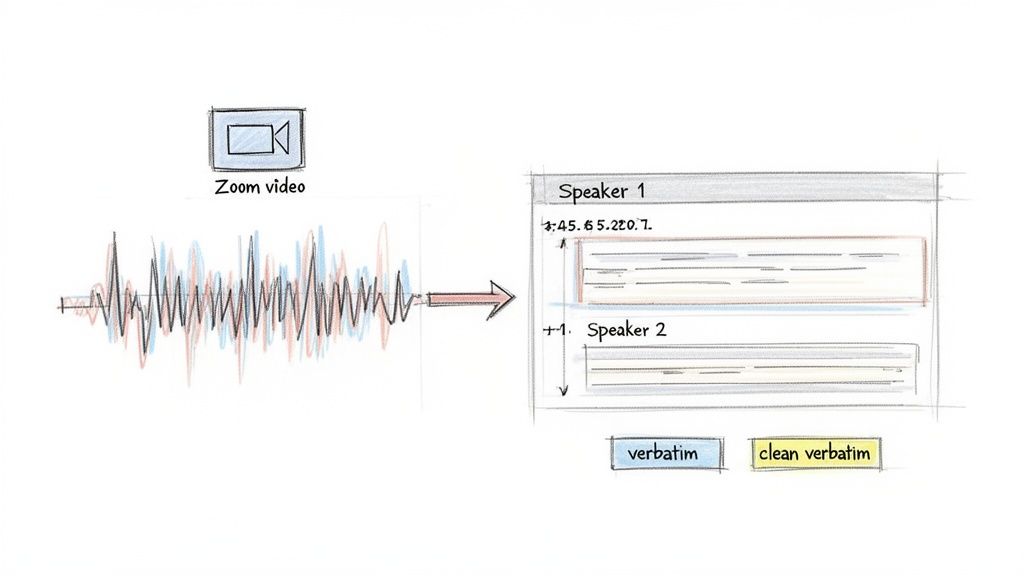
At its core, transcription is the process of converting spoken words from an audio or video file into written text. The key thing to remember is that this all happens within the same language. The goal isn’t to switch languages, but simply to change the format from something you hear to something you can read.
This simple conversion is powerful. It turns a fleeting conversation into a permanent, searchable document. Imagine a project team using Notize AI to record a Zoom call. They don’t just get a wall of text; they get a structured transcript with timestamps and speaker labels, turning a dynamic discussion into an organized record. Suddenly, that spoken content becomes accessible and much easier to analyze or reuse.
Understanding the Transcription Process
The path from audio to text follows a few clear steps, whether a person is doing the work or an AI platform like Notize AI is handling it. The process always starts with an audio or video file—it could be anything from a recorded meeting or podcast to a university lecture or a journalist's interview.
Today's tools make this incredibly fast. An AI model "listens" to the recording, recognizes the words being said, and converts them into a text document. More advanced systems like Notize AI go a step further by distinguishing between different speakers and pulling out summaries, key insights, and action items from the transcript. This transforms a basic text file into a genuinely useful asset, saving teams from hours of manual work. To get a better sense of the mechanics, you can read more about how to transcribe audio to text.
Types of Transcription
Not every transcript is the same. The type you need depends entirely on what you plan to do with it, and knowing the difference is crucial for getting a helpful result.
Verbatim Transcription: Think of this as the most literal option. It captures every single sound, including filler words ("um," "uh"), stutters, repeated words, and even non-verbal cues like laughter. This level of detail is critical for legal depositions or academic research where every utterance could be significant.
Clean Verbatim Transcription: This is the go-to for most business and content needs. It’s a lightly edited version that removes the filler words, fixes small grammatical mistakes, and tidies up repetitions. The result is a clean, readable text that faithfully preserves the speaker's intended meaning without the distracting clutter.
Key Takeaway: For most professional uses—like creating meeting minutes, turning a webinar into a blog post, or making study guides from lectures—clean verbatim is the perfect fit. Tools like Notize AI are built for this, delivering an accurate transcript that’s ready to use right away.
So, What's Translation and Why Does It Matter?
While transcription is about changing the format of your content (from spoken to written), translation is about changing the language. It’s the craft of taking something written or spoken in one language and accurately conveying it in another.
But it’s so much more than just swapping out words. Good translation keeps the original meaning, tone, and cultural context alive. This is what makes it crucial for any business that wants to expand its horizons. If you're launching a product in a new country or supporting international customers, translation is what builds that connection.
Going from Local to Global
The real magic happens when you pair high-quality transcription with expert translation. Think about it: your team just finished a fantastic product demo video. The very first thing you need is a perfect written record of everything said.
You can upload that demo to a tool like Notize AI to get a clean, accurate transcript. This text file then becomes the solid foundation for the next step. From there, you can hand it off to be translated into Spanish, German, or Japanese, opening up entirely new markets. This two-step process ensures your message stays consistent and clear, no matter where it's heard.
A Critical Insight: You can't build a great translation on a shaky foundation. Starting with a bad transcript is a recipe for disaster. Every single mistake will be carried over and often magnified in the new language, resulting in confusing—or even embarrassing—content that can hurt your brand.
Human vs. AI Translation: What’s the Difference?
When it comes to translation, you essentially have two paths to choose from, and each has its place.
Human Translation: This is when a professional linguist, who lives and breathes both languages, does the work. They understand the idioms, the cultural inside jokes, and the subtle nuances that machines often miss. This is the gold standard for anything important, like legal contracts or creative ad campaigns.
AI-Powered Translation: AI models are incredibly fast, capable of translating huge amounts of text in a blink. They’re fantastic for getting the general idea of a document or for less formal internal chats where speed is the top priority.
Today, many teams are using a hybrid approach—letting AI do the initial heavy lifting and then having a human expert come in to polish and perfect it. It’s a smart way to get both speed and quality.
The global translation market, valued at around USD 56.18 billion back in 2021, is massive compared to the transcription market. This shows just how vital it is for international business. For any team working with global content, using Notize AI to create a flawless transcript first is simply the smartest way to kick off the entire process. You can learn more about these market forces in this detailed industry analysis.
Choosing the Right Service for Your Business Goals
Figuring out whether you need transcription or translation isn't just about definitions—it’s about your end game. The right choice comes down to who you're trying to reach and what you want to accomplish. Are you simply trying to document what was said in a meeting? Or are you getting ready to take your brand global?
For anything related to internal efficiency, accessibility, or turning spoken content into written assets, transcription is where you start. It’s the perfect tool for creating searchable meeting notes, turning a webinar into dozens of SEO-friendly blog posts, or adding captions to make your videos inclusive. For instance, teams using Notize AI can turn a messy brainstorming session into an organized set of notes and action items, all in the original language.
Translation, on the other hand, is your ticket to the world stage. It's essential when you’re launching a marketing campaign in a new country, localizing your website for different regions, or offering customer support to a multilingual audience. Translation is all about building a connection and making sure your message hits home, culturally and linguistically.
A Framework for Making the Call
To make it simple, think about it this way: is your content meant for internal records or external communication? This decision tree can help you visualize which path to follow based on your ultimate goal.
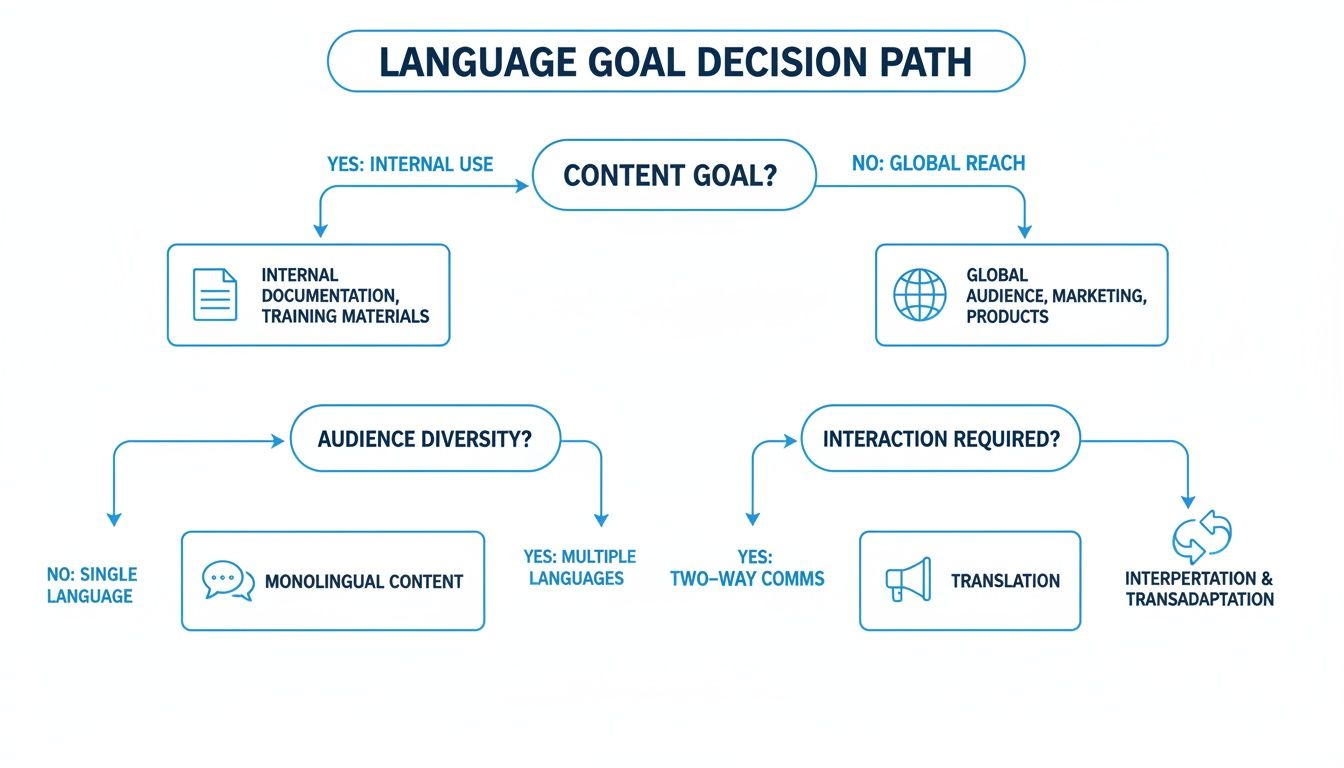
As you can see, while translation is what gets you into global markets, nearly every successful workflow starts with a clean, accurate source document. That's exactly what transcription delivers.
The market sizes for these services tell a similar story about their roles. The global translation market was a massive $60.68 billion in 2022 and is expected to climb to $96.21 billion by 2032, fueled by globalization. In contrast, the transcription market sat at $21.01 billion, but its value is in operational speed and providing the raw material for other content. For anyone creating content, transcription’s real magic is its immediacy.
Why Quality Transcription Should Always Come First
Here’s a crucial piece of advice that businesses often miss: great translation is built on the foundation of great transcription. If you try to translate directly from an audio file or a shoddy transcript, you’re setting yourself up for a "garbage-in, garbage-out" situation. Every error, mumbled phrase, or bit of incorrect jargon gets magnified in the final translation, which can lead to mistakes that are both costly and embarrassing.
Key Insight: Always start with a clean, accurate transcript. It saves time, money, and a whole lot of headaches down the line by making sure your source material is perfect before it gets passed on for translation.
By using a tool like Notize AI to get a precise, speaker-labeled transcript first, you create a perfect source document. Taking this one step seriously makes any translation effort that follows worlds better and more efficient. Before you even start pricing out translators, it’s worth understanding what goes into creating that clean source text. For a closer look, check out our guide on the cost of transcription services. This foundational step ensures your message stays clear and powerful, no matter the language.
How Notize AI Powers Your Content Workflow
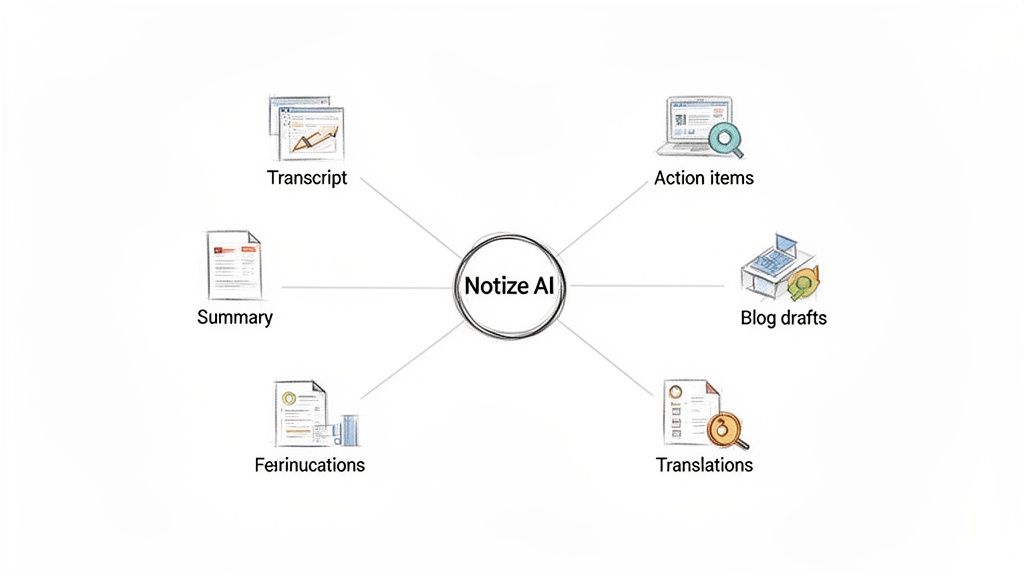
Knowing the difference between transcription and translation is one thing. Actually putting that knowledge to work requires a solid workflow that can handle each step without getting messy. Modern content isn't a straight line; it's more like an ecosystem where audio, video, and text flow into one another. This is where having a central hub like Notize AI becomes a game-changer.
Instead of trying to patch together separate tools for recording, transcribing, and summarizing, platforms like Notize AI pull the entire process under one roof. It all starts with getting the foundation right—the transcription. By delivering it with impressive accuracy and speed, every piece of content, whether it's a team meeting or a YouTube video, starts with a clean, reliable text version.
From Raw Audio to Actionable Insights
Let's say you’re a project manager just wrapping up an important client call. Taking notes by hand is slow and you're bound to miss something. With Notize AI, you can record the meeting right in the app. As soon as you hang up, the platform automatically generates:
A full, structured meeting summary with key discussion points.
Detailed notes that are clearly attributed to each speaker.
An organized list of action items and follow-up tasks.
This immediate output turns a simple conversation into a searchable, actionable record. For teams, this keeps everyone on the same page without a single person having to be the designated notetaker. You can even search by keyword across all past meetings and jump directly to the exact moment a topic was discussed.
Unlocking Content for Creators and Students
This kind of workflow isn't just for the corporate world. For content creators, journalists, and bloggers, Notize AI is a serious idea multiplier. That one-hour podcast interview can be transcribed and then quickly turned into several blog posts in any writing style—professional, conversational, or friendly. Creators can even build and publish their own blog directly within the app.
Students can use it to turn a long lecture into a much more manageable study guide. Just upload a recording, a YouTube link, or even a PDF, and you get back a full transcript, a summary of important concepts, and simplified explanations. You can even ask the AI questions about the lecture and get instant answers with timestamps pointing to the exact moment the professor covered it.
The Notize AI Advantage: By automating that first, crucial transcription step with high precision, the platform saves you a ton of time and eliminates the usual friction in your workflow. This frees you up to focus on the creative stuff—analyzing, creating, and sharing—instead of just capturing information.
Ultimately, by nailing the foundational transcription, Notize AI makes everything that comes after it faster and more accurate. Whether you’re documenting internal meetings, creating content for an audience, or getting a document ready for translation, it all begins with a perfect transcript. A platform that masters this first step is the key to a truly efficient content strategy.
See how you can build a smarter workflow for yourself by learning more about Notize AI and what it can do.
Frequently Asked Questions
When you're trying to figure out the best way to handle your audio and text, a few questions pop up time and time again. Let's clear up some of the common confusion around transcription and translation so you can build a workflow that actually works for you.
Can I Use Translation Software to Transcribe Audio?
This is a common mix-up, but the short answer is no. Translation software is designed for one specific job: converting written text from one language to another. It simply doesn't have the technology to listen to an audio file and turn spoken words into text.
That first step is purely the job of a transcription service. You need a tool built for the task, like Notize AI, which is engineered to process audio from your meetings or videos and generate an accurate transcript in the original language. Think of transcription as the mandatory first step before translation can even enter the picture.
Is Transcription or Translation More Expensive?
Translation almost always costs more, and for good reason. It’s a highly specialized skill that demands more than just being bilingual. A great translator needs deep cultural awareness, an understanding of nuance, and often specific industry knowledge to get the meaning just right. That level of human expertise, plus the necessary quality checks, adds to the price.
On the other hand, automated transcription has become incredibly affordable. AI-powered platforms like Notize AI can process hours of audio for a small fraction of what manual transcription used to cost. This gives you the clean, accurate source text you need for any next steps, including a future translation project.
What Is the Difference Between Translation and Localization?
Great question. People often use these terms interchangeably, but they refer to two very different levels of effort.
Translation is the literal, word-for-word (or phrase-for-phrase) conversion of text from a source language to a target language. The main goal is linguistic accuracy.
Localization goes much deeper. It’s about adapting your entire product or piece of content for a specific market. This involves translating the text, of course, but it also means adjusting cultural references, images, humor, date formats, and even colors so the content feels completely natural to a local audience.
Essentially, translation is just one piece of a much larger localization puzzle.
Why Is an Accurate Transcript So Important for Translation?
A high-quality translation is built on the foundation of an accurate transcript. It’s that simple. If your starting transcript is riddled with errors—misheard words, wrong names, or speakers mixed up—those mistakes will be baked directly into the translation. In fact, they often get magnified, resulting in a final product that’s confusing or just plain wrong.
Think of it as the "garbage-in, garbage-out" principle. Using a reliable tool like Notize AI to get a clean source document isn't just a nice-to-have; it's essential for any serious global content strategy. It's the only way to ensure your message lands correctly in every language.
Starting with a precise transcript from a tool like Notize AI is the best thing you can do to guarantee a successful translation down the line. It saves a massive amount of time and money on cleanup and corrections later.
Ready to get your workflow started on the right foot? With Notize AI, you can effortlessly turn your meetings, videos, and audio files into accurate transcripts, actionable summaries, and polished content. Stop chasing notes and start creating impact.
Difference Between Transcription and Translation Explained