So, you're trying to figure out how much transcription should cost. The short answer is, it depends. You could pay as little as $0.05 to $0.15 per minute for an automated AI service, or as much as $1.50 to $5.00 per minute for a human expert.
The real question isn't just about price, but about what you actually need. Are you looking for a quick, affordable way to handle everyday recordings, or do you need absolute precision for something like a legal deposition or a medical report? Your final bill will come down to that choice.
What Drives the Cost of Transcription Services
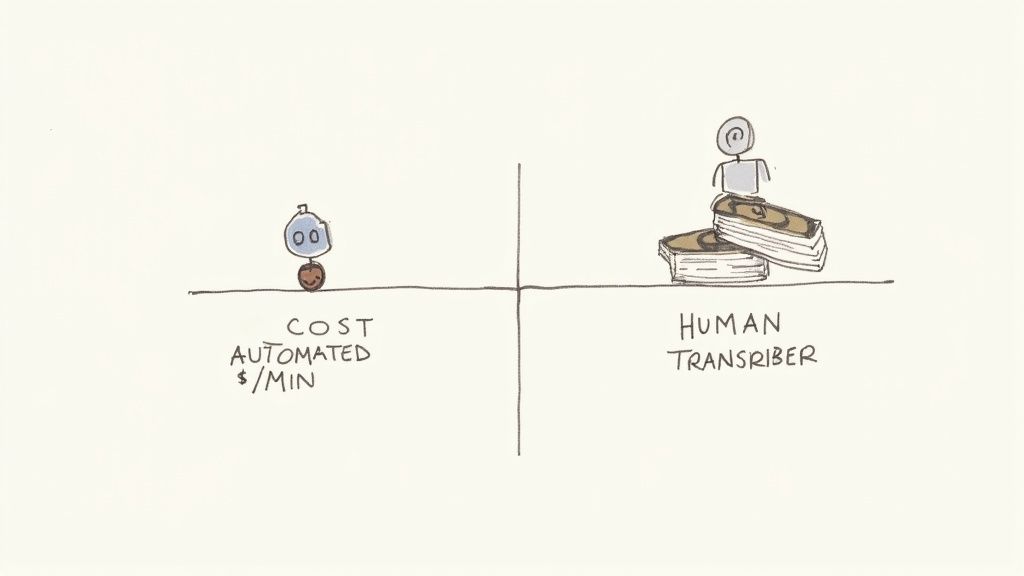
When you start shopping for transcription, you'll quickly realize there are two main paths you can take: services powered by artificial intelligence and those done by human hands. They each solve a different problem, and their pricing reflects that. Getting this right from the start is key to getting good value without paying for bells and whistles you don't need.
The Two Main Transcription Camps
Automated AI transcription is the go-to for speed and budget-friendliness. Platforms like Notize AI are built for efficiency, making them a perfect match for anyone who needs to quickly pull information out of an audio or video file. We're talking about professionals who want instant meeting notes, students who need to turn lectures into study guides, or journalists repurposing an interview into a blog post. With Notize AI, the turnaround is almost immediate, and the cost is a fraction of the alternative.
On the other side, you have manual human transcription. This is your premium, white-glove service. It's where you turn when accuracy is non-negotiable—think legal proceedings, medical dictations, or academic research where every word matters. A trained professional can deliver a transcript with 99% or higher accuracy. Naturally, that level of detail costs more and takes longer to produce.
The core decision comes down to balancing cost with required accuracy. For the majority of daily business and creative tasks, AI provides more than enough precision and unlocks powerful features beyond simple text conversion.
To make this even clearer, here's a quick side-by-side look at what you can expect.
Transcription Services Cost at a Glance
This table breaks down the essentials to help you see where your needs might fit.
Service Type | Typical Cost (Per Minute) | Average Turnaround Time | Best For |
|---|---|---|---|
Automated AI | $0.05 - $0.15 | Minutes | Meeting notes, interviews, content creation, student lectures, general use |
Manual Human | $1.50 - $5.00 | 24-72 Hours | Legal depositions, medical records, academic research, certified transcripts |
As you can see, the difference is significant. For most people, paying 10-20 times more for a human service just isn't necessary when an AI tool gets the job done well enough.
Why AI is Gaining Ground
The shift toward automated solutions isn't just a trend; it's a massive market movement. The global AI transcription market is expected to jump from USD 4.5 billion in 2024 to around USD 19.2 billion by 2034. Why the explosion? Because businesses of all sizes need an efficient, scalable way to document everything. The low cost of AI makes this possible for everyone, not just large corporations. For more on this, check out the automated transcription market's growth on sonix.ai.
But here's the real game-changer: modern AI platforms do so much more than just convert speech to text. A tool like Notize AI, for instance, can take a single recording and give you a whole suite of useful content:
Structured Meeting Summaries: Forget reading a 30-page transcript. Get the key takeaways, decisions, and insights in seconds.
Action Items and To-Do Lists: Notize AI automatically identifies tasks and follow-ups, so everyone knows what's next.
Content Repurposing: Instantly generate blog posts, social media updates, or email newsletters from your recording, in any writing style you choose.
This kind of value-add makes AI a smarter choice, not just a cheaper one. If you're curious to see it in action, you can explore some of the best free transcription software to get a feel for how these tools can streamline your workflow.
Getting to Grips with Transcription Pricing Models
Figuring out how transcription services bill you is the first real step to keeping costs in check. It’s a lot like picking a mobile phone plan—the right choice can save you a bundle and keep you from getting hit with unexpected charges later on. Most companies use one of three main pricing structures, and each one is a better fit for different kinds of projects and people.
Let’s break these down with some simple analogies so you can easily see which one makes sense for you, whether you're a professional who needs to capture meeting notes, a student transcribing lectures, or a creator repurposing video content.
Per-Audio-Minute Pricing
The most common and easy-to-understand model is per-audio-minute pricing. This is basically the pay-as-you-go of transcription. Think of it like filling up your car with gas—you pay for the exact amount you put in. If you upload a 30-minute audio file, you get a bill for 30 minutes of transcription. Simple.
This model is wonderfully transparent and predictable, which makes it a favorite for one-off projects or if you only need transcriptions every now and then. The catch? If your recordings have a lot of long pauses or dead air, you’re still paying for that time. For professionals in stop-and-start meetings or students recording meandering lectures, you could end up paying for minutes that don't contain any useful speech.
Per-Word or Per-Line Pricing
Another approach, though you'll see it less often for everyday transcription, is per-word or per-line pricing. This works a lot like how a freelance writer might charge for an article. Instead of billing based on the audio's runtime, the final cost is calculated from the total number of words or lines (a "line" is usually around 65 characters) in the finished transcript.
This can actually work in your favor if the audio is packed with fast, dense speech because you’re only paying for what's actually said. But it can get pricey with speakers who are a bit long-winded or if you need every single "um" and "ah" included. You'll typically find this model in highly specialized fields, like medical or legal transcription, where the final document's length is the standard way to measure the work.
The Subscription Model: A Modern Approach
The pricing model that's really picking up steam is the subscription model. This is like having an all-access gym membership. Instead of paying each time you go, you pay a flat monthly or yearly fee for a certain number of transcription minutes or a whole bundle of features. This completely reframes the whole idea of value.
A subscription model shifts the focus from a simple per-minute transaction to a partnership in productivity. It's not just about getting a transcript; it's about what you can do with it.
This is exactly where a platform like Notize AI comes into its own. Instead of just handing you a text file, Notize AI wraps its transcription service in a powerful toolkit designed to make your content do the heavy lifting for you. For a single subscription fee, you get:
High-accuracy transcriptions for your meetings, lectures, and videos.
Automated meeting summaries that instantly pull out key discussion points and insights.
Action items and to-do lists generated right from the conversation.
Instant content generation, turning a single video into multiple blog posts or social media updates with a click.
Think about a team that has several meetings every week. Under a per-minute model, the cost of transcription services would stack up fast. With Notize AI, all those meetings are covered by one predictable fee. A content creator can upload a one-hour YouTube video and walk away with not just a perfect transcript, but a blog post ready to publish. The subscription turns what used to be a simple expense into a smart investment in your own efficiency.
The Key Factors That Drive Up Transcription Costs
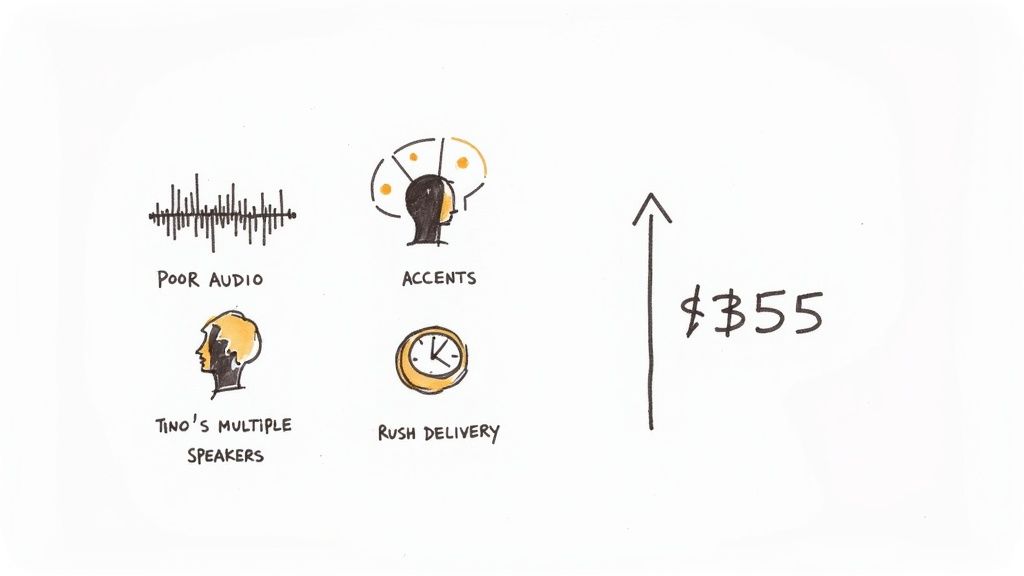
Ever wondered why one 30-minute recording cost you twice as much to transcribe as another of the exact same length? The short answer is that not all audio is created equal. A handful of key variables can dramatically increase the time and effort a transcriptionist has to put in, which, in turn, drives up your final bill.
Getting a handle on these factors is the first step to managing your budget and knowing what to expect. Think of it as a pre-flight checklist for your audio files. Each one of these elements adds another layer of difficulty that can inflate your quote, especially when you're using a manual service.
Audio Quality is Paramount
By far, the single biggest factor influencing your transcription bill is the quality of the audio recording. A clean, crisp recording is a breeze to transcribe, whether for a human or an AI. But the moment the audio gets muddy, the job becomes exponentially harder.
Several common issues can sabotage your audio quality and spike the cost:
Background Noise: A humming air conditioner, clattering dishes in a coffee shop, or sirens wailing in the street can easily drown out words, forcing a transcriber to rewind and re-listen over and over.
Microphone Distance: If a speaker is too far from the mic, their voice becomes faint and hard to make out. This requires a lot more concentration and guesswork to capture everything accurately.
Poor Recording Gear: Using a cheap microphone or the wrong recording settings can leave you with muffled, distorted audio that’s a nightmare to work with.
A file with bad audio can easily double the transcription time. Because of this, many services will tack on a "difficult audio" surcharge, often adding an extra $0.50 to $1.00 per minute.
The Human Element: Speaker Complexity
Beyond the technical quality, the way people actually speak plays a huge role in the final cost. Human speech isn't always neat and tidy, and certain habits make a transcriber's job much tougher.
For instance, a fast-paced brainstorming session where people are constantly talking over each other is incredibly challenging to untangle. It takes painstaking effort to figure out who said what, and when. Likewise, strong or unfamiliar accents can slow things down, as the transcriber may need to relisten to certain phrases to guarantee accuracy.
The more speakers you add to a recording, and the more they overlap, the more complex the transcription becomes. Each additional speaker can increase the manual effort required for accurate speaker identification and dialogue separation.
A simple one-on-one interview will always be cheaper to transcribe than a focus group with ten people chiming in. This is where a modern AI tool like Notize AI has a clear edge. Notize AI is built to automatically handle multiple speakers, separating and labeling who said what without the hefty surcharges traditional services apply. This makes it perfect for busy professionals needing to capture detailed meeting notes where speaker attribution is key.
Service-Level and Time Constraints
The last major cost driver comes down to your specific needs and deadlines. Most human transcription services offer a standard turnaround time of 24 to 72 hours. If you need it done faster, get ready to pay a premium.
Here are a few service-level options that will bump up your bill:
Rush Delivery: Need that transcript in under 12 hours? You can expect to pay a rush fee that can add anywhere from $0.50 to $1.25 per minute to your total.
Verbatim Transcription: If you need every single "um," "ah," stutter, and false start captured, you’re asking for strict verbatim. This requires more intense focus and time, so services charge extra for it.
Time Stamping: Adding timestamps at regular intervals or every time the speaker changes is another common add-on that will increase the per-minute rate.
These extras might seem small, but they add up quickly, turning what looked like an affordable project into a surprisingly expensive one. This is why it's so important to know exactly what you need from the start. For many people—from students recording lectures to video enthusiasts summarizing long YouTube videos—a platform like Notize AI offers a more holistic solution. It doesn't just transcribe; it also generates summaries and action items, delivering far more value without all the a la carte pricing of older services.
Watching Out For Hidden Fees and Extra Charges
The per-minute rate you see advertised is rarely the full story. Think of it as the starting price, not the final bill. Many traditional transcription services build their pricing around a basic, no-frills transcript. Anything you need beyond that—like knowing who said what or getting an exact word-for-word record—starts adding up.
This is where your budget can quickly get derailed. To avoid any nasty surprises on your invoice, it's crucial to dig a little deeper and ask what's included in that base rate and, more importantly, what isn't.
Common Surcharges That Increase Your Bill
When you're looking at a manual transcription service, you'll often find a menu of optional add-ons. While these can be essential for your project, each one will nudge your final cost higher.
Here are a few of the most common extras that can inflate your bill:
Timestamping: Need to sync your transcript with your audio or video? Adding time markers at specific intervals is a must, but it'll typically cost you an extra $0.25 to $0.50 per minute.
Strict Verbatim Transcription: A standard transcript cleans up the conversation, removing all the "ums," "ahs," and stutters. If you need a transcript that captures every single sound for detailed analysis, you'll have to pay for "strict verbatim" service, which can add another $0.25 to $0.50 per minute.
Difficult Audio Handling: As we've discussed, things like heavy background noise, strong accents, or multiple people talking at once make a transcriber's job much tougher. You can expect to see a surcharge for this, often between $0.50 to $1.00 per minute, to cover the extra time and effort required.
It’s easy to see how these fees can stack up, sometimes even doubling what you thought you were going to pay.
The real cost of transcription services often lies in the fine print. A low per-minute rate can be misleading if essential features like speaker identification or verbatim accuracy are treated as premium add-ons.
On top of these, other services can also be tacked on. Here’s a quick look at what else might pop up on your bill.
Common Transcription Add-Ons and Their Potential Costs
This table breaks down some of the extra services that can increase your final transcription bill.
Add-On Service | Typical Extra Cost (Per Minute) | When You Might Need It |
|---|---|---|
Speaker Identification | $0.25 - $0.50 | For interviews, meetings, or focus groups with multiple participants. |
Rush Delivery | 25% - 100% Surcharge | When you're on a tight deadline and need a transcript back in hours, not days. |
Foreign Language/Heavy Accent | $0.50 - $2.00+ | For audio with non-native English speakers or strong regional dialects. |
Technical/Specialized Terminology | $0.25 - $0.75 | For content that requires expert knowledge, like medical or legal dictation. |
As you can see, the little things really do add up, turning a simple task into a significant expense.
A Modern, All-Inclusive Alternative
This nickel-and-diming approach is exactly what newer platforms like Notize AI were built to solve. Instead of you having to pick and choose features from a menu, Notize AI bundles everything you need into one straightforward subscription. This shifts transcription from being a simple line item to a powerful tool for productivity.
With a Notize AI subscription, you get far more than just words on a page. For example, a project manager can record a client call and almost instantly get a full transcript, a concise summary, key takeaways, and a list of action items—all without paying extra for each piece. Speaker identification, a feature that often costs a premium with traditional services, is just part of the package.
This is a game-changer for creators and content consumers, too. A journalist can upload a podcast episode and let Notize AI generate a ready-to-publish blog post in their own writing style. A user can send a link from YouTube and get insights and highlights in seconds. You're turning one piece of media into several assets without a cascade of hidden fees. It’s a much clearer way to manage your costs while getting significantly more value.
Choosing Between AI and Human Transcription
So, what's the right move for your project: AI or a human transcriber? This is the central question everyone faces, and the answer directly impacts your budget, turnaround time, and how you can use the final transcript.
It really boils down to a classic trade-off. On one side, you have the lightning speed and low cost of AI. On the other, you have the meticulous, near-perfect accuracy of a human expert. Understanding this dynamic is the first step to getting a handle on the cost of transcription services. There's no single "best" choice—the right one is all about what you need to accomplish.
When AI Transcription Is the Smart Choice
AI transcription has completely changed the game for day-to-day productivity. Its main advantages are speed, affordability, and the ability to plug into other workflows. An AI tool like Notize AI can turn your audio into text in minutes, not days. This makes it the go-to option when you need to act on information quickly and don't need a flawless, word-for-word record.
Think about these real-world scenarios:
For Professionals and Teams: Record a team meeting and Notize AI instantly produces a transcript, a structured summary of key discussion points, and a neat list of action items and decisions. The recording becomes a genuine productivity tool, not just a file sitting in a folder.
For Journalists and Creators: A blogger can upload an interview and have Notize AI generate a full, SEO-friendly blog post in their preferred writing style. They can even build their own blog within the app and publish directly.
For Students: Record a two-hour lecture, and Notize AI provides a complete set of searchable notes moments after it ends. Students can even ask AI questions about the material and jump to the exact moment a topic was explained.
For Everyday Users: Send a long YouTube video link to Notize AI and get a summary in seconds, turning hours of content into actionable insights without watching the whole thing.
In these cases, the goal isn't perfection; it's about pulling out valuable information and putting it to use. For the vast majority of business, creative, and academic tasks, Notize AI is more than accurate enough. To see how it all works under the hood, check out our guide to automated transcription services.
When Human Transcription Remains Essential
Even with all the progress in AI, there are still times when you absolutely need a human. For situations where every single word matters and precision is non-negotiable, a trained professional is the only way to guarantee 99.9% accuracy.
Human transcription is the gold standard for:
Legal Proceedings: When a transcript is used as court-admissible evidence or for depositions, it has to be a certified, verbatim record. There's no room for error.
Medical Records: Dictated patient notes and clinical reports demand absolute precision. A small mistake could lead to serious errors in treatment or billing.
High-Stakes Research: In-depth academic or market research often depends on capturing every nuance of a conversation, including hesitations and subtle inflections that an AI might overlook.
This level of detail costs more and takes longer, but for these critical applications, it's a necessary investment. The global medical transcription market is a perfect example, projected to hit USD 104.96 billion by 2030. This growth is fueled by the relentless demand for accuracy in healthcare. While many providers have looked to outsourcing to manage costs, the need for human review is still there.
This simple flowchart lays out the decision-making process based on your accuracy requirements.
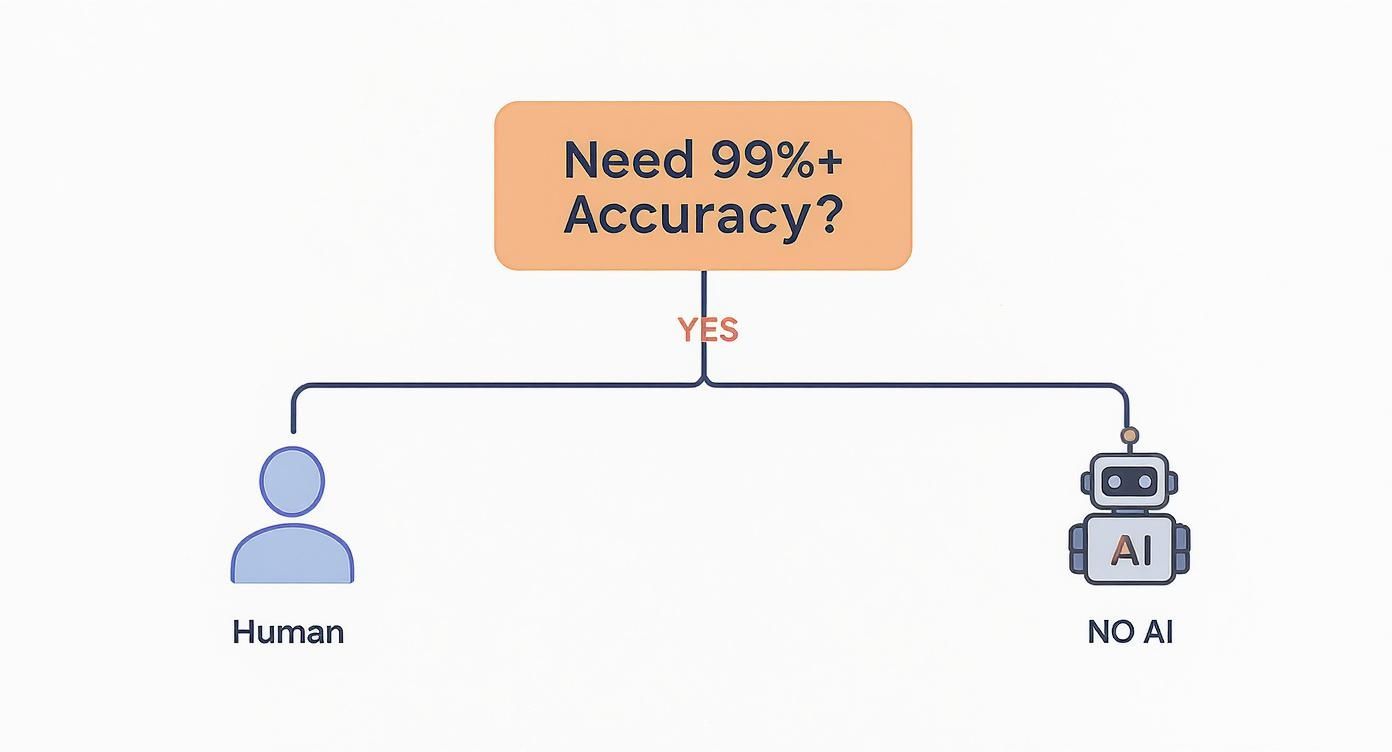
The takeaway is straightforward: if your project is for legal, medical, or other high-stakes purposes where near-perfect accuracy is a must, you need a human. For just about everything else related to productivity and content creation, AI offers a smarter, faster, and more cost-effective path.
Ultimately, it’s a strategic decision. If you're looking to summarize a video or share notes from a meeting, a tool like Notize AI is the intelligent, affordable solution. But if you're a lawyer building a case, a human transcriber is the only responsible choice. Knowing the difference lets you pick the right tool for the job, every time.
How Notize AI Maximizes Your Return On Investment
When you’re looking at the cost of transcription services, it’s easy to get fixated on the price tag. But experienced pros know the real calculation is about the value you get back. The true return on investment (ROI) comes from reclaiming your time and sidestepping manual work. A simple text file is just the beginning; the real goal is to turn raw audio into something that actually makes you more productive.
This is where a tool like Notize AI goes from being an expense to an investment. It’s not just about what you transcribe, but what you can immediately do with it. The platform is built to handle all the tedious follow-up tasks that eat up your week.
Turning Time Saved Into Tangible Value
Think about a project manager who sinks four hours every single week just typing up meeting notes and chasing down action items. With Notize AI, that entire workflow happens on its own. The meeting ends, and the platform delivers structured summaries, key talking points, and a clean to-do list. Those four hours are suddenly free for higher-level strategic work.
The ROI of an intelligent platform like Notize AI is measured in reclaimed hours and accelerated workflows. It transforms a passive recording into an active asset that drives your projects forward.
Or consider a content creator. They can upload a single one-hour video to Notize AI and walk away with a week’s worth of SEO-ready blog posts, social media captions, and newsletter snippets. Instead of paying per minute for a basic transcript and then spending days reformatting it, Notize AI gives you ready-to-use assets in minutes. The value isn’t in the text itself—it's in the speed.
More Than a Transcript—It's a Productivity Engine
Notize AI pays for itself by replacing the need for a patchwork of different tools. By combining transcription with smart analysis, it becomes a single hub for all kinds of professionals.
For Teams: Automated summaries keep everyone on the same page, and nobody has to be the designated notetaker. An AI meeting note taker can completely change how your team collaborates.
For Students: Lectures are instantly transformed into organized study guides. With Notize AI, you can upload not just recordings but also PDFs, slides, and ebooks for analysis.
For Creators: Audio and video become high-quality written content. Notize AI even provides AI-powered suggestions to make your storytelling more engaging.
By focusing on outputs that save time and amplify your effort, Notize AI delivers a return that quickly outstrips its subscription cost. It’s an essential tool for anyone who wants to work smarter, not harder.
Frequently Asked Questions About Transcription Costs
Let's tackle some of the most common questions people have about transcription pricing. Getting straight answers will help you budget wisely and pick the right service without paying for bells and whistles you just don't need.
What Is a Reasonable Price for Transcription?
Honestly, a "reasonable" price is one that matches your specific needs.
For the bulk of professional and creative work—like turning meeting recordings into notes, drafting blog posts from interviews, or creating study guides—an AI service like Notize AI is a game-changer. With an affordable subscription, the cost often breaks down to less than $0.20 per minute, which is incredible value.
On the other hand, if you're dealing with something that requires near-perfect accuracy, like a transcript for legal evidence or a complex medical report, you'll need a human. In those cases, a rate of $1.50 to $5.00 per minute is standard and expected. The trick is to avoid paying that premium for 99%+ accuracy when your project simply doesn't require it.
How Can I Lower My Transcription Costs?
The single biggest thing you can do to cut costs is to improve your audio quality. It sounds simple, but it makes a massive difference.
Record in a quiet space, use a decent microphone, and encourage speakers to avoid talking over each other. This preparation makes the transcription process smoother and more accurate, whether you're using an AI or a human service.
If you find yourself needing transcripts regularly, a subscription to an AI platform like Notize AI is almost always the most budget-friendly move. You get a flat fee instead of a ticking per-minute clock. Plus, Notize AI goes a step further by automatically generating summaries and action items, saving you even more time and manual effort down the line.
Is AI Transcription Good Enough for Professional Use?
Absolutely. For the vast majority of professional tasks today, AI is not just good enough—it's often the smarter choice.
High-accuracy platforms like Notize AI are perfect for busy professionals who need instant meeting summaries and to-do lists without having to jot down notes. They're also a lifeline for content creators who want to quickly turn a video interview into a polished blog post.
While a human expert is still the gold standard for high-stakes legal or medical scenarios, AI has become the go-to tool for the everyday needs of most professionals, students, and creators. It’s about turning a simple recording into something you can actually use, boosting productivity and saving you precious time. With Notize AI, you're not just getting a transcript; you're getting a full suite of tools to understand and repurpose your content instantly.
Ready to see how much more you can get done? Notize AI transforms your audio and video into summaries, action items, and shareable content in minutes. It's time to stop just transcribing and start achieving.
The True Cost of Transcription Services Revealed