For small businesses, content marketing often feels like a resource-draining battle against larger competitors. The constant demand for fresh blog posts, social media updates, and videos can be overwhelming. But what if your most valuable content is already being created every day in your meetings, customer calls, and team discussions? This article provides seven actionable content marketing tips for small businesses, showing you how to unlock this hidden potential. We'll explore practical strategies that don't require a massive budget or a dedicated content team.
Instead of starting from scratch, you'll learn how to leverage smart tools like Notize AI to capture, analyze, and repurpose your existing knowledge into a powerful content machine. By turning internal conversations and client interactions into polished assets, you can consistently publish authentic, expert-driven content. For example, with Notize AI, a team meeting can be automatically transcribed, summarized, and converted into action items, while a journalist can upload an interview and receive a draft blog post in their preferred writing style. This guide will walk you through transforming meeting notes into blog posts, customer feedback into case studies, and team brainstorming sessions into social media content. Let's dive into how you can work smarter, not harder, to make your content marketing efforts drive real growth, build authority, and connect with your audience on a deeper level.
1. Repurpose Meeting Recordings and Calls into Multiple Content Assets
Stop thinking of content creation as a process that always starts from a blank page. One of the most effective content marketing tips for small businesses is to treat your existing conversations, meetings, and calls as raw material for a wide range of content assets. Every Zoom interview, team brainstorm, or customer feedback session is a goldmine of authentic insights, quotes, and ideas waiting to be repurposed.
This "content multiplier" strategy maximizes the return on your time. Instead of creating a single blog post from scratch, you can transform one hour-long recording into a dozen different pieces of content. For example, a marketing team can use a tool like Notize AI to record a customer interview and automatically generate a full transcript, a detailed summary, key takeaways, action items, and even a draft blog post. That same recording can then be edited into short video clips for social media, audio snippets for a podcast, and compelling quotes for a case study.
How to Implement This Strategy
To get started, focus on documenting conversations you are already having. The goal is to capture authentic moments and expert knowledge without adding significant new work.
Customer Calls & Interviews: Record customer success calls or interviews. With Notize AI, you can upload these recordings and instantly extract their pain points, success stories, and direct quotes. This material is perfect for creating relatable case studies, testimonials, and sales collateral that speaks directly to your prospects' needs.
Internal Brainstorms & Team Meetings: Your internal meetings are filled with expert discussions. Record these sessions and use an AI tool like Notize AI to pull out key insights, decisions, and action items. This can be repurposed into internal documentation, training materials, or even "behind-the-scenes" blog posts that showcase your company culture and expertise.
Webinars & Live Videos: After hosting a webinar, don't just post the recording. Upload the video link to Notize AI to transcribe it, generate a comprehensive summary for a blog post, pull out key statistics for an infographic, and identify impactful moments for short video clips.
For a deeper dive into specific workflows, explore these content repurposing strategies that can help you scale your output efficiently.
2. Create Data-Driven Content Using Analytics and Performance Insights
Move beyond guesswork and let data guide your content creation process. One of the most impactful content marketing tips for small businesses is to use analytics to understand what truly resonates with your audience. By analyzing performance insights, you can stop wasting resources on content that falls flat and double down on the topics, formats, and channels that drive meaningful results. This data-driven approach transforms your strategy from a series of random shots in the dark into a calculated and effective system for growth.
Instead of guessing what your audience wants, you can make informed decisions based on real user behavior. For instance, analytics might reveal that your "how-to" video tutorials get twice the engagement of your written blog posts. This insight allows you to confidently allocate more resources to video production. Even better, platforms like Notize AI allow creators and journalists to publish content directly and access analytics to see how their audience interacts with each post, closing the loop between creation and performance.

How to Implement This Strategy
Start by leveraging the analytics tools you already have access to, such as Google Analytics, your social media platform insights, or your email marketing software. The goal is to identify patterns and turn them into actionable content ideas.
Analyze High-Performing Topics: Look at your most viewed blog posts, most shared social media updates, or most-clicked email links. These topics are proven winners. Plan a series of "sequel" content that explores these themes in greater depth, such as creating an in-depth guide, a webinar, or a video series based on your most popular post.
Identify Engaging Formats: Review metrics like engagement rate, time on page, and video watch time. If you find that short-form videos on Instagram generate the most comments and shares, prioritize creating more of them. You can use Notize AI to summarize long videos into key takeaways perfect for short-form content.
Pinpoint Top-Performing Channels: Determine which channels are driving the most traffic and conversions. If you discover that LinkedIn is your primary source of qualified leads, focus your efforts on creating professional, insightful content tailored specifically for that platform's audience. This ensures your best content reaches the right people.
For a comprehensive guide on tracking the right metrics, you can learn more about how to measure content performance and turn that data into a powerful strategy.
3. Implement a Content Calendar Built from Meeting Insights and Action Items
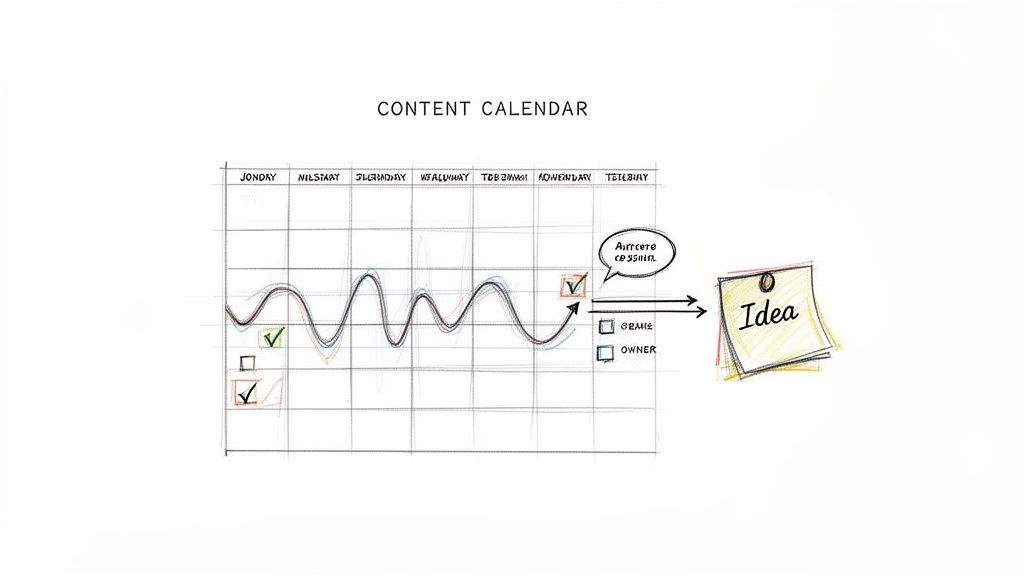
Great content ideas often die in meeting rooms, lost in a sea of conversation and forgotten notes. One of the most strategic content marketing tips for small business owners is to create a system where meeting discussions directly fuel your content calendar. This approach transforms abstract conversations, customer feedback, and strategic decisions into a structured, actionable content production workflow. Instead of brainstorming from scratch, your content is always aligned with real-time business priorities.
This method ensures that your content production is not an isolated activity but a direct outcome of your core business operations. For instance, a small business can use a tool like Notize AI to record a quarterly planning session. The AI can automatically extract key initiatives, target audience pain points, and action items, which can then be converted into a series of blog posts, social media updates, and email campaigns for the upcoming quarter. This creates a direct bridge between strategic planning and content execution.
How to Implement This Strategy
To start, make it a habit to review meeting outcomes specifically for content opportunities. The goal is to build a systematic process for capturing, prioritizing, and scheduling content ideas that arise naturally from your daily work.
Customer Success Calls: Your customer success team is on the front lines, hearing about customer challenges and wins every day. Use insights from these calls to populate your content calendar with topics for "how-to" guides, FAQ pages, and case studies that address the most common user questions.
Product & Strategy Meetings: Action items from product roadmap discussions or strategy sessions are perfect for creating content that showcases your company’s vision and upcoming features. With Notize AI, these action items are automatically generated, making it easy to track and assign content tasks.
Sales Win/Loss Calls: Analyze recordings of sales calls to identify the key selling points that resonate with customers and the objections that need to be overcome. This information is invaluable for creating targeted sales collateral, battle cards, and blog posts that support the sales team.
By systematically converting meeting discussions into planned content, you ensure every piece you create is relevant, timely, and supports a specific business goal. To streamline this process, you can explore this guide to creating action items from your meetings and feeding them directly into your content plan.
4. Build Authority with Consistent Publishing of Thought Leadership Content
Instead of just selling your product or service, focus on selling your expertise. One of the most powerful content marketing tips for small businesses is to establish your brand as an industry authority by consistently publishing original thought leadership. This means sharing your unique insights, perspectives, and proprietary data to build trust and credibility with your target audience. When customers see you as a leading voice, they are more likely to turn to you when they are ready to buy.
This strategy shifts your content from being purely promotional to being genuinely valuable. By sharing what you know, you are not just marketing; you are educating and empowering your audience. For example, a small team can record an internal strategy session discussing future industry trends, use a tool like Notize AI to transcribe and summarize the key predictions, and then turn that raw insight into a compelling LinkedIn article. This positions your team as forward-thinking experts without requiring extensive original research.
How to Implement This Strategy
To begin, identify the core areas where your business has a unique point of view or specialized knowledge. The goal is to own a niche conversation within your industry.
Identify Your Core Themes: Pinpoint 2-3 topics where your team has genuine expertise. This could be based on your company's proprietary data, a unique process you have developed, or a contrarian viewpoint on a common industry practice.
Commit to a Consistent Schedule: Authority is built through consistency. Commit to a regular publishing schedule, whether it's a weekly LinkedIn post, a bi-weekly blog article, or a monthly original research report. Consistency trains your audience to look for your content.
Leverage Internal Expertise: Your team is a goldmine of thought leadership. Record internal discussions, Q&A sessions with your experts, or customer feedback reviews. Use an AI tool like Notize AI to extract key insights, quotes, and data points that can be polished into articles, social media posts, or podcast segments. This showcases the diverse expertise within your company.
Engage in the Conversation: Publishing is only half the battle. Actively engage with comments and discussions on your content. Answering questions and participating in dialogue further solidifies your position as an accessible and knowledgeable expert in your field.
5. Optimize Content Distribution Across Multiple Channels with One Hub
Creating great content is only half the battle; ensuring it reaches your audience is just as crucial. One of the most impactful content marketing tips for small businesses is to centralize your distribution efforts. Instead of manually posting to your blog, then your email, then each social media platform, use a single hub to manage, schedule, and publish content across all your channels simultaneously. This approach dramatically reduces friction, saves countless hours, and ensures a consistent brand message everywhere your audience is active.
This "hub-and-spoke" distribution model transforms your workflow from a series of repetitive, time-consuming tasks into a streamlined, efficient process. For example, a marketing team using a tool like Notize AI can generate a blog post from a meeting recording and then, from the same dashboard, share key insights and a link to that post across social media channels and into an email newsletter. This maximizes the reach of every single content asset without multiplying the workload, allowing small teams to compete with the output of much larger organizations.
How to Implement This Strategy
Start by auditing your channels and creating a centralized system for planning and execution. The goal is to make publishing as seamless as content creation.
Audit Your Channels: Identify every platform where your target audience congregates. This could include your blog, LinkedIn, Twitter, Facebook, Instagram, and email newsletters. Don't spread yourself too thin; focus on the channels that deliver the best results.
Use a Central Hub Tool: Adopt a social media management tool like Buffer or Hootsuite to schedule posts across multiple platforms. For a more integrated approach, tools like Notize AI allow you to not only generate content but also organize it in folders and share it instantly, bridging the gap between creation and promotion.
Create Channel-Specific Templates: Don't just copy and paste the same message everywhere. Create simple templates that adapt your core message for each channel. For instance, a LinkedIn post might be professional and detailed, while an Instagram caption could be more visual and concise.
Batch and Schedule Content: Set aside dedicated time each week to schedule all your content. This "batching" method is far more efficient than posting in real-time and ensures a consistent presence even when you're busy with other tasks.
6. Develop a Content Library That Becomes a Competitive Asset
Stop creating content that gets used once and then forgotten. One of the most powerful content marketing tips for small business owners is to systematically build an internal, searchable library of all your content assets. This includes everything from meeting notes and customer insights to multimedia files and published articles. Over time, this organized repository becomes a proprietary knowledge base that speeds up content creation, ensures brand consistency, and creates a competitive moat that others cannot easily replicate.
Instead of starting from scratch for every new campaign, your team can pull from a rich, internal resource. Imagine your marketing team needing a customer quote for a landing page; they can instantly search a library of transcribed customer calls managed with a tool like Notize AI. The platform’s keyword search lets you find the exact moment a topic was discussed across all past meetings, making asset retrieval effortless. This approach transforms disconnected assets into a unified, strategic tool, empowering your team to build on past work and create higher-quality content with less effort.

How to Implement This Strategy
The goal is to create a single source of truth that your entire organization can rely on. Start by choosing a central location and establishing clear organizational rules.
Establish Naming and Tagging Conventions: Create a consistent system for naming files and organizing them into folders or teams. This is the foundation of a searchable library. For example, with Notize AI, you can organize all academic materials, meeting notes, or client projects into customizable folders.
Centralize All Raw Materials: Use a tool like Notize AI to automatically record, transcribe, and summarize every important conversation, from customer feedback calls to internal product brainstorms. It can also process YouTube links, PDFs, and Word documents, storing these organized records in your central library so your team can search past discussions for quotes, pain points, and fresh ideas.
Create a Content Audit Schedule: Set a recurring time (quarterly or bi-annually) to review your library. Archive outdated materials, update evergreen content, and identify gaps that your future content strategy can fill. This ensures your asset library remains relevant and valuable.
Document and Promote Internally: Create a simple guide that explains what is in the library, how to search for assets, and how to contribute new content. Encourage your team to check the library first before creating anything new to avoid duplicate work and leverage existing resources.
7. Create Engagement Through Authentic, Summarized Insights and Takeaways
Instead of always creating new, high-effort content, one of the most impactful content marketing tips for small business is to share the genuine insights you're already generating. Your daily conversations, team meetings, and customer calls are filled with valuable learnings. By summarizing and sharing these takeaways, you provide direct value to your audience, establish your expertise, and build a community around shared knowledge.
This strategy positions your brand as a transparent and helpful resource. For instance, after a customer feedback session, you can use a tool like Notize AI to capture the key pain points and success stories discussed. These can be anonymized and shared as "Customer Insights of the Week" in a newsletter or a LinkedIn post. For students, Notize AI can turn a long lecture into a concise summary and study guide, demonstrating how summarized content provides immediate value. This approach transforms routine business activities into authentic content that resonates.
How to Implement This Strategy
The goal is to create a consistent cadence of sharing valuable, bite-sized information that your audience can immediately use. This builds trust and keeps your brand top-of-mind.
Customer & Sales Calls: Record sales calls and customer interviews. Use Notize AI to automatically pull out common objections, feature requests, or surprising use cases. Anonymize the details and share them in a weekly newsletter titled "5 Things We Learned from Customers This Week."
Internal Team Meetings: Your product and marketing brainstorms are full of strategic discussions. Capture these sessions and share high-level takeaways. A product leader could post a thread on X (formerly Twitter) about the top three learnings from a recent sprint planning meeting, showcasing your team's thought process.
Webinars & Podcasts: After an event, go beyond sharing the full recording. Use Notize AI to generate a concise summary and a list of key takeaways from the media link. Post these as a carousel on Instagram or a short article on LinkedIn, asking your audience which point resonated most with them.
For more ideas on how to turn your existing media and conversations into engaging content, explore these methods for repurposing content to boost your engagement.
7-Point Small Business Content Marketing Comparison
Strategy | 🔄 Implementation Complexity | ⚡ Resource Requirements | ⭐ Expected Outcomes | 💡 Ideal Use Cases | 📊 Key Advantages |
|---|---|---|---|---|---|
Repurpose Meeting Recordings and Calls into Multiple Content Assets | Medium — setup for transcription and templates | Medium — transcription/repurposing tools + occasional editor | ⭐⭐⭐ Increased content volume and ROI from existing recordings | Teams with frequent meetings, podcasts, or user interviews | Scales production; preserves insights; consistent pipeline |
Create Data-Driven Content Using Analytics and Performance Insights | Medium — analytics setup and dashboards | Medium–High — analytics tools, tracking, analyst time | ⭐⭐⭐ Better targeting, optimized content, justified budget allocation | Organizations with traffic/data who want to optimize strategy | Removes guesswork; identifies high-ROI topics; continuous improvement |
Implement a Content Calendar Built from Meeting Insights and Action Items | Low–Medium — integrate extraction to calendar workflow | Low–Medium — calendar tool, process discipline | ⭐⭐ Improved alignment, fewer missed ideas, steady output | Teams needing follow-through (marketing, product, CS) | Ensures accountability; aligns content with priorities; reduces follow-ups |
Build Authority with Consistent Publishing of Thought Leadership Content | High — ongoing editorial and research process | High — writers, research, sustained time/resources | ⭐⭐⭐ Long-term credibility, inbound leads, pricing power (compounding) | Brands aiming to differentiate and attract customers/talent | Differentiation; trust-building; durable competitive moat |
Optimize Content Distribution Across Multiple Channels with One Hub | Medium — central platform setup and channel configuration | Medium — distribution platform, templates, minor tailoring | ⭐⭐–⭐⭐⭐ Wider reach, consistent messaging, time saved on publishing | Teams/agencies publishing across many channels | Time-savings; consistent branding; scalable distribution |
Develop a Content Library That Becomes a Competitive Asset | High — taxonomy, tagging, migration, governance | High — KM platform, ongoing maintenance, access controls | ⭐⭐⭐ Reusable knowledge, faster production, long-term asset value | Organizations with large content/knowledge needs (enterprise, agencies) | Reusability; preserves institutional knowledge; speeds onboarding |
Create Engagement Through Authentic, Summarized Insights and Takeaways | Low–Medium — extraction plus editorial curation | Low — summarization tools and editor review; permission checks | ⭐⭐ High engagement and trust from concise, shareable insights | Social/newsletter-driven engagement and community building | Drives engagement; builds credibility; quick-to-publish snippets |
From Overwhelmed to Optimized: Your Next Steps in Content Marketing
Navigating the world of content marketing can feel like an overwhelming task for a small business, where time and resources are always at a premium. However, the strategies outlined in this article demonstrate a powerful, more sustainable path forward. The core principle is not about creating more content, but about working smarter with the knowledge and assets you already possess. By shifting your perspective, you can transform everyday business activities into a robust and efficient content engine.
The most potent content marketing tips for small business revolve around integration and repurposing. Instead of seeing content as a separate, time-consuming task, view it as a natural byproduct of your operations. Your team meetings, customer calls, and internal strategy sessions are goldmines of authentic insights, expert opinions, and relevant topics. The key is to build a system that captures this raw intelligence and effortlessly refines it into valuable assets like blog posts, social media updates, and thought leadership articles.
Your Actionable Path Forward
To turn these concepts into reality, focus on building a simple, repeatable workflow. Here are the most crucial takeaways to implement immediately:
Start with What You Have: Your next team meeting is your first piece of content. Use a tool like Notize AI to record, transcribe, and summarize it. Pull out key discussion points, actionable advice, or a unique perspective to form the basis of a blog post or a series of social media updates.
Systematize Your Process: Don't let content creation be an afterthought. Use the insights from your captured conversations to build a content calendar. This data-driven approach ensures your topics are always relevant and aligned with your team's expertise and your audience's interests.
Build a Central Knowledge Hub: Every piece of content you create, from a summarized meeting to a polished article, should be stored and organized. With Notize AI, this internal library becomes a competitive advantage, allowing you to quickly find information, answer customer questions, and maintain brand consistency.
Mastering these approaches means you can finally step off the content creation hamster wheel. You will no longer struggle for ideas or spend hours drafting content from scratch. Instead, you'll have a streamlined system that turns your team's collective genius into a powerful marketing force. This strategic approach not only saves immense amounts of time but also ensures your content is authentic, authoritative, and deeply connected to your business's core value. By implementing these content marketing tips for small business, you build a sustainable engine for growth that works for you, not against you.
Ready to turn your team's conversations into powerful marketing content? Stop creating from scratch and start leveraging your existing knowledge. Discover how Notize AI can automatically transcribe, summarize, and repurpose your meetings and calls into ready-to-publish assets. Visit Notize AI to build your content engine today.
7 Actionable Content Marketing Tips for Small Business in 2026