In the relentless race for audience attention, the pressure to constantly create new content can lead to burnout. But what if the secret to scaling your output isn't about creating more, but about creating smarter? Effective content repurposing strategies are the cornerstone of efficient marketing, allowing you to multiply the value of every piece you produce without starting from scratch. By transforming a single high-value asset into a variety of formats, you can reach new audiences, reinforce your message, and maximize your return on investment.
This approach isn't just about saving time; it's about strategic amplification. A deep-dive webinar can become a series of social media clips, a detailed blog post, and an insightful infographic. A single customer interview can be transformed into a compelling case study, a powerful testimonial video, and a data-rich presentation slide. This method ensures your best ideas achieve maximum reach and impact across different platforms and audience preferences.
This article provides a comprehensive roundup of 10 proven content repurposing strategies designed for marketers, creators, and product teams. We'll explore actionable workflows, highlight key metrics for success, and show you how platforms like Notize AI can automate the heavy lifting. Using a tool like Notize AI, you can upload a single recording and instantly generate summaries, blog drafts, and action items, turning one piece of media into a dozen unique assets. Prepare to unlock a more sustainable and impactful approach to content marketing.
1. Blog-to-Social Media Content Repurposing
One of the most foundational and effective content repurposing strategies is transforming comprehensive, long-form blog posts into a variety of bite-sized assets for social media. Instead of letting a valuable blog post sit passively on your website, this strategy actively deconstructs it into multiple, targeted social media updates. This approach not only extends the lifespan of your original content but also amplifies its reach to different audience segments across various platforms.
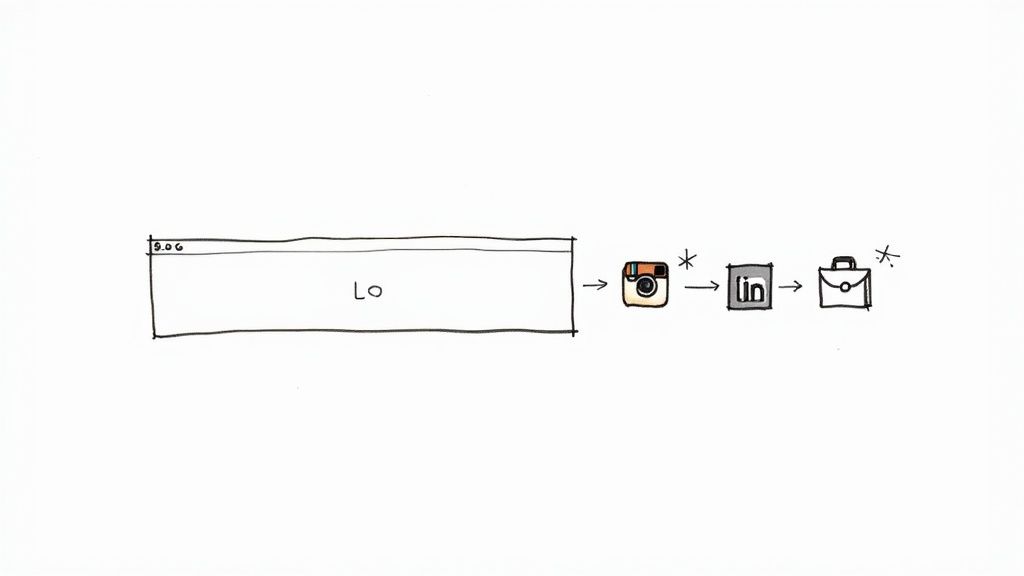
This method involves extracting key statistics, compelling quotes, actionable tips, and core concepts from a single article. These elements are then reformatted into platform-native content like quote graphics, short video clips, Instagram carousels, LinkedIn text posts, or Twitter threads. The goal is to meet your audience where they are with content optimized for how they consume information on each specific platform.
How to Implement This Strategy
A systematic workflow is crucial for turning this strategy into a repeatable process. Start by identifying your highest-performing or most evergreen blog posts as primary candidates for repurposing.
Deconstruct the Core Content: Break down the blog post into its fundamental components. Pull out key statistics, expert quotes, step-by-step instructions, and main arguments. Each component can become a standalone social media post.
Create Platform-Specific Assets: Adapt the extracted content for different channels. For example, a "Top 5 Tips" section can become a visually engaging Instagram carousel, a text-based LinkedIn post, and a multi-tweet thread.
Automate and Schedule: Use social media management tools to schedule the distribution of these assets over several weeks. This creates a sustained promotional campaign for a single blog post, driving continuous traffic. With Notize AI, you can even take this a step further by uploading documents or pasting links to generate unique social media copy in different tones, making content creation even faster.
Pro Tip: Create a content pillar map that links one central blog post to 10-15 related social media posts. This ensures a cohesive and non-repetitive social media calendar built around a single piece of high-value content.
2. Long-Form to Short-Form Video Conversion
Capitalizing on the explosive growth of short-form video is one of the most powerful content repurposing strategies available today. This approach involves transforming lengthy video assets like webinars, podcasts, or interviews into engaging, bite-sized clips optimized for platforms such as TikTok, Instagram Reels, and YouTube Shorts. Instead of letting valuable long-form video content underperform, this strategy maximizes its ROI by reaching audiences with shorter attention spans.
This method requires identifying the most compelling "peak moments" within your original content. These key insights, surprising statistics, or powerful quotes are then extracted and edited into standalone clips, often enhanced with captions, graphics, and trending audio to boost algorithmic visibility. The goal is to deliver concentrated value that hooks viewers instantly and encourages them to seek out the full-length original.
How to Implement This Strategy
A streamlined workflow is key to consistently producing high-quality short-form video without a massive time investment. Begin by analyzing your long-form video's analytics to pinpoint segments with the highest engagement or viewer retention.
Identify and Extract Key Moments: Use analytics or AI tools to find the most impactful segments. For example, a platform like Notize AI can process a long YouTube video or webinar recording and automatically identify key moments with its timeline feature. It can also generate summaries and suggest potential clips, saving hours of manual review. Content consumers can even use Notize AI to chat with a video to ask questions and find the exact information they need without watching the whole thing.
Optimize for Vertical Viewing: Reframe and edit your clips for a vertical (9:16) aspect ratio. Add bold, easy-to-read captions, as a significant portion of short-form video is watched without sound. Also, ensure the audio is clear; you can learn more about how to reduce background noise on a mic for professional-quality sound.
Schedule and Cross-Promote: Distribute the clips across multiple platforms, each with a clear call-to-action directing viewers back to the full video or a related landing page. Test different formats, like a "best of" compilation or a series of clips from a single webinar.
Pro Tip: Create a template for your short-form clips with consistent branding (logo, colors, fonts). This builds brand recognition and makes the production process faster, allowing you to focus on finding the best content moments to share.
3. Podcast-to-Blog Article Conversion
A powerful yet often underutilized entry in the playbook of content repurposing strategies is converting audio-rich podcast episodes into comprehensive, SEO-friendly blog posts. This strategy unlocks your audio content, making it accessible to audiences who prefer reading and discoverable by search engines. By transcribing and enhancing your episodes with written context, you effectively double your content output from a single recording session, catering to different consumption habits.
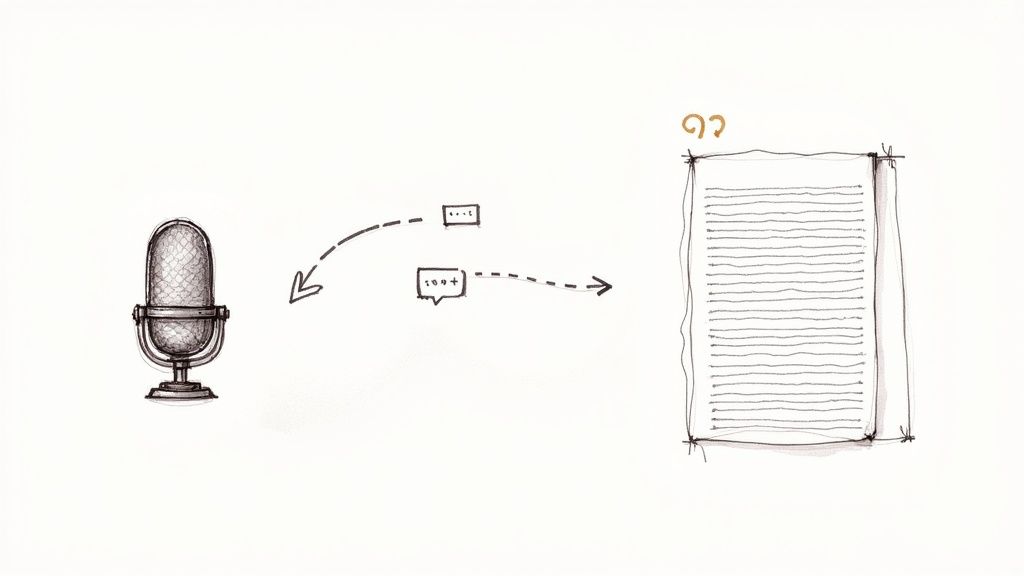
This method involves more than just a direct transcription. The best examples, like those from The Tim Ferriss Show or Pat Flynn’s Smart Passive Income blog, transform the spoken word into a structured, readable, and value-added article. This creates a permanent, searchable asset that drives organic traffic long after the episode airs, building a robust content archive.
How to Implement This Strategy
To execute this effectively, you need a process that streamlines the conversion from audio to polished text, ensuring quality and readability are prioritized.
Transcribe and Structure the Content: Start with an accurate transcription. Tools like Notize AI are ideal for creators, as they can generate high-quality transcriptions and even draft customizable blog posts directly from an audio file in any writing style. Once transcribed, structure the content with a compelling headline, an introduction, and clear subheadings that reflect the conversation's key topics.
Enhance and Optimize for Readability: Add elements that make the text scannable and engaging. Include an embedded audio player at the top, pull out impactful quotes as blockquotes, and add timestamps to help readers navigate to specific moments in the audio.
Enrich with Supplementary Resources: Elevate the post beyond a simple transcript. Add relevant images, links to resources mentioned in the episode, and bullet points summarizing key takeaways or action items. This provides additional value and improves the user experience. You can learn more about how to get a clean text version of your audio by reading our guide on how to transcribe audio to text.
Pro Tip: Don't just publish a raw transcript. Edit it for clarity and conciseness, correcting any grammatical errors and removing filler words. Rephrase conversational segments into clear, declarative sentences to improve flow and ensure the article stands on its own as a valuable piece of written content.
4. Case Study to Multiple Format Distribution
Transforming a single, in-depth case study into a multi-format content campaign is one of the most powerful content repurposing strategies for demonstrating product value and building social proof. This approach takes a detailed customer success story, often rich with data and testimonials, and atomizes it into various assets. Instead of a case study existing only as a PDF, its core message is amplified across blogs, videos, infographics, and social media.
This strategy maximizes the return on investment from the extensive research and client collaboration required to produce a compelling case study. Companies like Salesforce and HubSpot pioneered this method by turning customer wins into a continuous stream of marketing materials. The goal is to make your customer's success a central theme in your marketing, presented in formats that resonate with different audience segments on their preferred channels.
How to Implement This Strategy
A structured approach is key to getting the most mileage out of a single customer story. Begin with a comprehensive interview and data collection process to create a rich source document.
Deconstruct the Core Content: Start with a detailed case study document. Isolate the key elements: the client's initial problem, the solution your product provided, the implementation process, and the quantifiable results (e.g., ROI, time saved, revenue growth).
Create Platform-Specific Assets: Repurpose the isolated elements for different formats. The key metrics can become a visually striking infographic. The client’s testimonial can be turned into a short video clip or a series of quote graphics for social media. The problem-solution narrative can be expanded into a full blog post.
Automate the Groundwork: For video or audio testimonials from the client, a tool like Notize AI is invaluable. You can upload the interview, and it will automatically generate a full transcription, a summary of key wins, and even a draft blog post highlighting the success story. This automates much of the initial deconstruction, allowing your team to focus on creating and scheduling the final assets.
Pro Tip: Create a "Case Study Content Kit" for each success story. This kit should include the full PDF, a one-page summary, a presentation slide deck, 3-5 social media graphics with key stats, and a short video testimonial. This makes it easy for sales and marketing teams to access and use the content.
5. Webinar-to-Multiple Content Derivatives
Transforming a single webinar into a full suite of content assets is one of the most powerful content repurposing strategies for maximizing ROI on live event production. Webinars are inherently rich with expert insights, Q&A sessions, and structured presentations, making them a goldmine for derivative content. Instead of letting a valuable one-hour session fade after the live event, this strategy systematically breaks it down into various formats to engage audiences long-term.
This method involves taking the core webinar recording and deconstructing it into on-demand videos, lead magnet PDFs, blog post series, podcast episodes, social media clips, and even email course content. For instance, B2B SaaS companies like HubSpot and Marketo excel at turning their educational webinars into comprehensive whitepapers, blog series, and on-demand learning modules, ensuring the initial investment continues to generate leads and educate their audience for months or years.
How to Implement This Strategy
A proactive approach is key; plan your repurposing strategy before the live event to ensure you capture the necessary assets. This turns a one-time event into a sustainable content engine.
Deconstruct the Webinar Recording: After the event, use a tool to process the recording. Notize AI is perfect for this, as it can instantly generate a full transcription, a structured summary, a list of action items, and key discussion points. This initial breakdown provides the raw material for all other assets. For more guidance, learn more about recording a webinar effectively.
Create Diverse Content Formats: Use the deconstructed elements to build out your content calendar. The slide deck can become a SlideShare presentation or an Instagram carousel. The audio can be polished into a standalone podcast episode. The main talking points can be expanded into a series of in-depth blog posts.
Extract Micro-Content for Social Media: Isolate the most impactful 1-3 minute segments, such as a powerful quote, a surprising statistic, or a key Q&A moment. These clips are perfect for driving engagement on platforms like LinkedIn, TikTok, and Instagram Reels.
Pro Tip: Create a content matrix before your webinar. Map out each section of your presentation (e.g., Intro, Point 1, Point 2, Q&A) and pre-assign it to a derivative format (e.g., Point 1 becomes Blog Post #1, a key stat from Point 2 becomes a quote graphic). This streamlines the post-production workflow significantly.
6. User-Generated Content Curation and Aggregation
One of the most authentic content repurposing strategies involves curating and aggregating content created by your own audience. This approach transforms customer testimonials, community posts, and follower shout-outs into powerful marketing assets. Instead of solely relying on brand-created content, you leverage the voice of your customers to build trust, social proof, and a vibrant community around your brand.
This strategy centers on actively collecting, organizing, and showcasing user-generated content (UGC). It involves repurposing organic customer photos, reviews, videos, and stories into compelling marketing materials like testimonial galleries, social media features, and case study collections. The goal is to let your happiest customers become your most influential advocates, adding a layer of authenticity that branded content often cannot achieve.
How to Implement This Strategy
A structured system is key to ethically and effectively turning audience content into a cornerstone of your marketing. Start by establishing a clear process for discovering, requesting permission for, and featuring UGC.
Discover and Collect UGC: Create a branded hashtag (e.g., #GoPro, #Lululemon) and encourage your audience to use it when sharing their experiences. Monitor this hashtag, brand mentions, and tagged posts across social platforms to discover high-quality content.
Request Permissions and Attribute Clearly: Always request explicit permission from the original creator before repurposing their content. Once approved, give clear and prominent credit. This builds goodwill and encourages more users to share their content in the future.
Repurpose into High-Value Assets: Compile the best UGC into various formats. For example, a collection of positive customer video reviews can be edited into a powerful testimonial montage. Similarly, creator-submitted tutorials can be quickly repurposed using Notize AI. Simply upload the video, and the platform can instantly generate step-by-step guides or blog posts, preserving the user's authentic voice while creating a new, valuable asset.
Pro Tip: Launch a dedicated UGC campaign with a specific theme or contest. Offer incentives like gift cards, product discounts, or a feature on your official channels to boost participation and generate a high volume of quality content in a short period.
7. Pillar Content-to-Cluster Content Strategy
One of the most powerful SEO-focused content repurposing strategies is the pillar-cluster model. This approach involves creating a single, comprehensive "pillar" page that covers a broad topic in-depth. This long-form guide is then supported by multiple "cluster" content pieces, which are shorter articles targeting specific, related long-tail keywords. Each cluster piece links back to the main pillar page, signaling to search engines that you are an authority on the topic.
This strategy transforms a single, massive piece of content into a structured, interconnected content hub. By strategically repurposing a definitive guide into smaller, targeted posts, you can dominate search rankings for a wide range of related queries. Industry leaders like HubSpot have famously used this model to build immense topical authority in areas like "content marketing," with their central pillar page acting as the core of their entire content ecosystem.
How to Implement This Strategy
Executing a pillar-cluster model requires upfront strategic planning, particularly around keyword research and content architecture. It is a long-term play that builds sustainable organic traffic.
Build the Pillar: Start by conducting thorough keyword research to identify a broad, high-value topic. Create a comprehensive pillar page (often 5,000+ words) that serves as the definitive resource on that subject. This is your central asset.
Develop the Clusters: Repurpose sections of your pillar page into 10-20 focused cluster posts. Each post should target a specific long-tail keyword related to the main topic. With Notize AI, you can upload your pillar page document and ask the AI to generate ideas or even first drafts for your cluster posts, drastically speeding up the process.
Establish Strategic Linking: The linking structure is critical. Every cluster post must link back to the main pillar page. This internal linking framework is what establishes the topic cluster in the eyes of search engines.
Pro Tip: Use a content map or a mind-mapping tool to visually plan your pillar and cluster relationships. This helps ensure comprehensive topic coverage and prevents content cannibalization by clearly defining the scope of each cluster piece.
8. Content Serialization and Chapter Breakdown
Transforming a single, large-scale content asset into a serialized series is one of the most powerful content repurposing strategies for long-term audience engagement. Instead of publishing an ebook, research report, or online course as a single, overwhelming piece, this strategy breaks it down into a sequence of digestible chapters or episodes. This method keeps your audience coming back for more, building anticipation and extending the value of your core content over weeks or even months.
This approach involves taking a comprehensive asset and partitioning its chapters or modules into an episodic series distributed across channels like email, your blog, or social media. Each installment is a self-contained piece of value that also serves as a teaser for the next, creating a compelling narrative arc that maintains audience interest. It’s an ideal way to nurture leads and build a loyal following around a cornerstone piece of content.
How to Implement This Strategy
A successful serialization strategy requires careful planning before the first chapter is released. The key is to structure the series to maximize both individual chapter value and overall narrative momentum.
Plan the Entire Series Arc: Before publishing, map out the entire content series. Define each chapter, create compelling transitions or "cliffhangers" between installments, and establish a consistent publishing schedule. Use a clear naming convention (e.g., "Part 1," "Chapter 2") to help the audience follow along.
Optimize Each Chapter for Standalone Discovery: While part of a series, each installment should be valuable and understandable on its own. This ensures that new audience members can discover any chapter and still get immediate value, encouraging them to seek out the rest of the series.
Build a Central Hub: Create a dedicated landing page that collects all published chapters. As you release new installments, update this page. This hub becomes a valuable, evergreen resource that you can promote long after the initial series has concluded. A creator using Notize AI can upload a full video course, automatically generate blog posts for each module, and then publish them sequentially while linking back to a central series page.
Pro Tip: Use each chapter's release to build excitement for the next. End your blog posts, emails, or social threads with a teaser like, "In next week's chapter, we'll reveal the three biggest mistakes to avoid..." This keeps your audience invested and eagerly awaiting the next piece.
9. Data Visualization and Infographic Creation
Another powerful set of content repurposing strategies involves transforming complex data, statistics, and text-heavy reports into visually compelling infographics and charts. Humans process visual information far more quickly than text, and this method leverages that fact to make dense information digestible, memorable, and highly shareable. Instead of burying valuable research in a lengthy report, you can distill its key findings into a single, striking graphic.
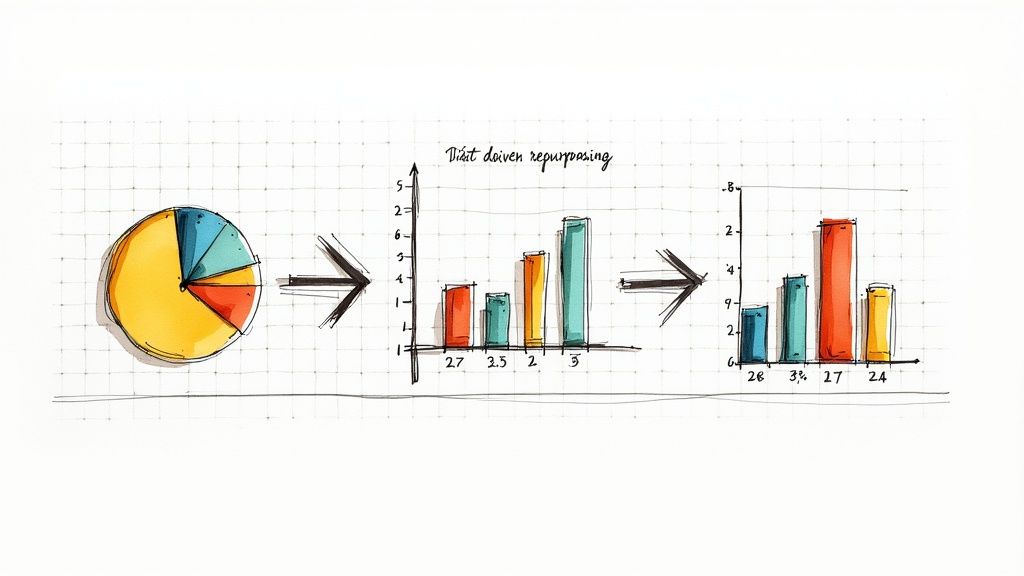
This strategy is particularly effective for data-driven content like market research, survey results, or annual reports. By converting numbers and bullet points into charts, graphs, and icons, you can communicate key insights at a glance. This not only caters to visual learners but also significantly increases the likelihood of your content being shared on platforms like Pinterest, LinkedIn, and Twitter, driving both engagement and brand authority.
How to Implement This Strategy
A successful data visualization strategy begins with identifying compelling data and ends with a clean, brand-aligned design. The goal is to simplify, not to overcomplicate.
Identify Key Data Points: Review your existing reports, white papers, or even meeting notes for standout statistics, trends, and comparisons. A single impactful number or finding can be the centerpiece of an entire infographic.
Choose the Right Format: Select a visual format that best represents your data. Bar charts are great for comparisons, line graphs show trends over time, and pie charts illustrate proportions. Tools like Canva, Piktochart, and Infogram offer templates to get you started.
Design for Clarity and Shareability: Use your brand's colors and fonts consistently. Keep the design uncluttered, with plenty of white space to guide the viewer's eye. Ensure you include your logo and website URL to drive traffic and brand recognition as it gets shared. For professionals, data from a team meeting recorded and summarized by Notize AI can be a great source for internal visualizations, turning spoken decisions and insights into shareable graphics.
Pro Tip: Don't just create one large infographic. Break it down into smaller, individual "chart-ables" or "stat-graphics." Each individual statistic or chart can be shared as a standalone social media post, extending the life and reach of your original research.
10. Content Remix and Update Repurposing
One of the most powerful yet underutilized content repurposing strategies involves revisiting and refreshing your existing content library. Instead of creating something new from scratch, this method breathes new life into older assets by combining, updating, and republishing them. This approach capitalizes on the existing SEO authority of your content while making it relevant and valuable for a modern audience.
This strategy is about turning your content archive into a dynamic, living resource. It involves identifying high-potential but outdated articles, enriching them with current data, combining related posts into a comprehensive "ultimate guide," and re-launching them. This not only improves user experience but also signals to search engines that your content is fresh and authoritative, often resulting in a significant boost in rankings and traffic.
How to Implement This Strategy
A successful content remix requires a strategic audit and a clear update process. The goal is to enhance value, not just change a few words. Start by identifying content that is either evergreen in topic but outdated in detail, or a high-performer that has seen a decline.
Audit and Prioritize: Use analytics to find blog posts with good historical traffic and keyword rankings that are now decaying. Prioritize foundational or "cornerstone" pieces that can be expanded into comprehensive guides.
Update and Enhance: Refresh all statistics, examples, and case studies with the most current information available. Remove any outdated advice or broken links. Use this opportunity to improve formatting, add new visuals, and embed relevant videos or media to increase engagement. For example, if you have a video interview on the topic, use a tool like Notize AI to generate a transcript and key insights to embed directly into the post, instantly adding depth and value.
Republish and Promote: Change the publication date to the current date and add a visible "Last Updated" note for transparency. Promote the updated post across your channels as if it were brand new, highlighting the fresh insights and data you've added.
Pro Tip: Combine several smaller, related blog posts into a single, long-form pillar page. For instance, three separate articles on "social media scheduling," "content creation," and "community management" can be remixed into a definitive guide on "Social Media Marketing Strategy for [Year]." This creates a high-value asset that attracts more backlinks and authority.
Top 10 Content Repurposing Strategies Comparison
Strategy | Implementation Complexity 🔄 | Resource Requirements ⚡ | Expected Outcomes 📊⭐ | Ideal Use Cases 💡 | Key Advantages ⭐ |
|---|---|---|---|---|---|
Blog-to-Social Media Content Repurposing | Medium — platform-specific formatting and scheduling | Low–Medium — writing/design tools, scheduling | Broader reach, steady traffic back to blog; improved engagement 📊 | Brands with existing long-form blogs wanting social presence | Cost‑effective extension of content life; multi-platform reach |
Long-Form to Short-Form Video Conversion | Medium–High — clip selection, edit and hook optimization | Medium–High — video editors, captioning, aspect ratio assets | High virality and reach; increased awareness and shares 📊⭐ | Video-heavy creators, podcasters, webinar producers | Maximizes video ROI; strong algorithmic advantage |
Podcast-to-Blog Article Conversion | Medium — transcription + editorial refinement | Low–Medium — transcription tools, editor | Better SEO, accessibility, searchable archives 📊 | Podcasts aiming for discoverability and readers | Leverages audio for search; improves accessibility and citation |
Case Study to Multiple Format Distribution | High — research, permissions, multi-format coordination | High — data analysis, design, video, copywriting | Authority building; high‑quality lead generation 📊⭐ | B2B, SaaS, professional services showcasing client wins | Demonstrates credibility; versatile lead magnets across channels |
Webinar-to-Multiple Content Derivatives | High — planning for repurposing, segmentation | High — recording setup, editing, transcription | Evergreen content library; multiple lead touchpoints 📊 | Educational webinars, product demos, lead-gen events | Converts live events into on-demand assets and funnels |
User-Generated Content Curation and Aggregation | Medium — moderation and rights management | Low–Medium — community tools, moderation resources | Authentic engagement, social proof, content volume 📊 | Consumer brands with active communities | Low-cost content creation; builds loyalty and trust |
Pillar Content-to-Cluster Content Strategy | High — hub-and-spoke planning and keyword mapping | Medium–High — research, many cluster pieces | Increased topical authority and improved search rankings 📊⭐ | SEO-driven content programs and resource hubs | Sustained organic growth via internal linking and depth |
Content Serialization and Chapter Breakdown | Medium — series planning and cadence management | Low–Medium — writing, email/platform scheduling | Prolonged engagement and subscriber retention 📊 | Courses, ebooks, long reports repurposed into sequences | Keeps audience engaged over time; repeat touchpoints |
Data Visualization and Infographic Creation | Medium–High — data design and editing | Medium–High — designers, visualization tools | Higher shareability, retention, and backlink potential 📊⭐ | Research reports, data-heavy posts, thought leadership | Communicates complex data quickly; drives backlinks |
Content Remix and Update Repurposing | Medium — audits, consolidation and updating | Low–Medium — research, editing, publishing | Improved freshness, retained SEO value, faster output than new content 📊 | Mature content libraries needing refresh and consolidation | Preserves backlinks/authority; cost‑efficient refresh strategy |
Build Your Content Engine with Notize AI
You’ve explored a comprehensive suite of content repurposing strategies, from transforming a single webinar into a dozen unique assets to breaking down pillar pages into a powerful content cluster. The journey through these ten methods reveals a powerful truth: your best content shouldn't be a one-time event. It should be the starting point for a continuous cycle of value creation that engages your audience across every conceivable platform.
Mastering these techniques means moving beyond the relentless "content treadmill" and adopting a smarter, more sustainable approach. It's about seeing the hidden potential within every blog post, podcast episode, and case study. Instead of constantly brainstorming new ideas from scratch, you can build a robust, interconnected content ecosystem where each piece supports and amplifies the others. This is the hallmark of a truly efficient and impactful content program.
Key Takeaways for Building Your Repurposing Flywheel
The core lesson from these strategies is that efficiency and creativity are not mutually exclusive. By establishing a system, you unlock more time for the strategic work that truly matters.
Systemize Your Workflow: The most successful content repurposing strategies are not random acts of inspiration; they are part of a repeatable process. Whether you are converting a podcast into a blog post or turning a case study into social media graphics, having a defined workflow is critical.
Think Multi-Format from the Start: Begin the content creation process with repurposing in mind. When planning a webinar, also plan the potential blog posts, video clips, and infographics that will follow. This proactive mindset makes the entire process smoother and more effective.
Leverage Technology to Scale: Manually transcribing videos, summarizing meetings, or pulling quotes is a significant time sink. This is where automation becomes a game-changer. A platform like Notize AI can handle the heavy lifting, instantly extracting the raw materials you need from your audio, video, and text-based content.
Your Actionable Next Steps
To move from theory to practice, you need a clear plan. Start small, build momentum, and integrate these practices into your existing content calendar.
Conduct a Content Audit: Identify your top-performing "pillar" content. Which blog posts, videos, or podcasts have generated the most engagement or leads? These are your prime candidates for repurposing.
Choose One Strategy to Master: Don't try to implement all ten strategies at once. Pick one that aligns with your current goals, such as turning your most popular blog post into a series of short-form videos for social media.
Integrate an Automation Hub: This is where Notize AI becomes your central nervous system for content. For creators, it can turn a single video into a high-quality blog post. For students, it converts lectures into study guides. For professionals, it transforms meeting recordings into summaries and action items. This single step transforms your content repurposing strategies from a manual chore into an automated, scalable engine.
Ultimately, the power of content repurposing lies in its ability to maximize the value of every minute you invest in content creation. It ensures your message reaches more people, in more formats, on more channels, without burning out your team. By building a system powered by smart automation like Notize AI, you are not just creating more content; you are building a lasting library of assets that will continue to drive results long after their initial publication.
Ready to stop the manual work and start building a powerful, automated content engine? Explore how Notize AI can instantly transcribe, summarize, and transform your media into dozens of ready-to-publish assets. Visit Notize AI to see how our platform can supercharge your content repurposing strategies today.
10 Powerful Content Repurposing Strategies to Scale Your Marketing in 2025