Back to blog
Customer Success Onboarding Process: A Proven Guide to Delight New Customers
Dec 22, 2025
Think of customer success onboarding as the roadmap you give new clients. It’s the carefully planned journey that takes them from "I just signed up" to "Wow, this is exactly what I needed." This isn't about sending a welcome email and hoping for the best. It's a hands-on strategy built around kickoff calls, focused training, and consistent check-ins to get them to that first big win with your product.
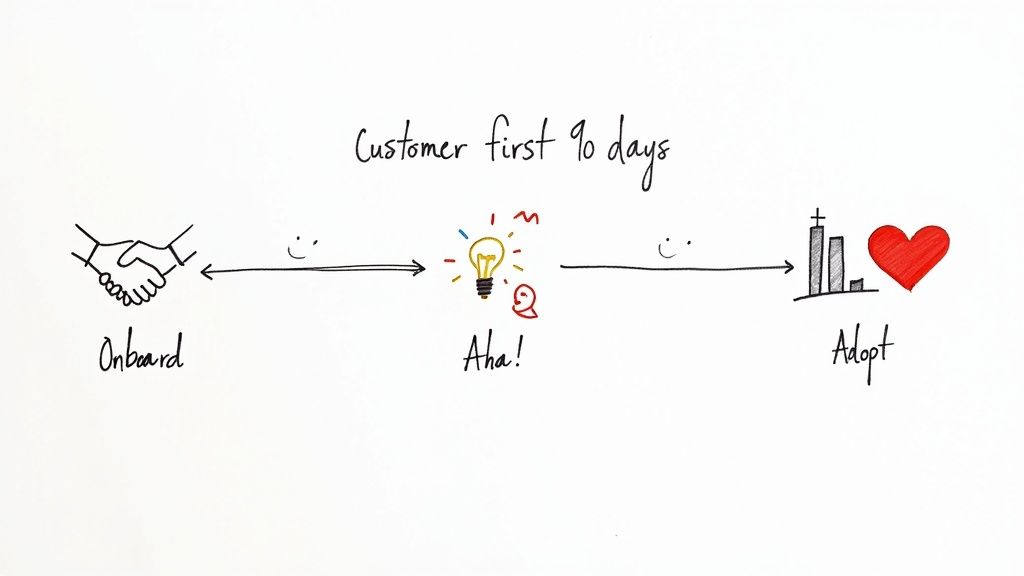
Those first 90 days are everything. They set the stage for a long-term relationship and are your best defense against early churn.
Why Your Onboarding Process Defines Customer Success
The very beginning of a customer relationship dictates the entire future. It's like building the foundation of a house—if it's shaky, the whole thing is unstable. A great onboarding process does more than show off your features; it validates the customer's decision to buy from you and delivers on your promises right out of the gate.
This early period is where you build momentum and trust. It's your prime opportunity to lead customers to that "Aha!" moment, the instant they see how your solution solves their specific problem. If you miss this window, you risk them becoming disengaged, never fully adopting the product, and eventually, leaving.
From First Call to First Value
Every conversation during onboarding is a fact-finding mission. Your kickoff and discovery calls are treasure troves of information about what your customer truly wants to achieve, their biggest frustrations, and what they expect from you. Getting this down accurately is non-negotiable if you want to deliver a personalized experience. This is where the right tools can make all the difference.
For instance, using a tool like Notize AI to record and analyze those initial meetings gives you an immediate, searchable transcript. The platform can pull out a structured summary, highlight key discussion points, and even generate a list of action items from the conversation. This gives the Customer Success Manager a single source of truth, ensuring no customer goal gets lost in the shuffle. With Notize AI, professionals can organize meetings into team folders, share reports instantly, and ensure everyone has a clear, consistent understanding of what happened—without anyone needing to take notes manually.
A strong onboarding process isn't just about showing features; it's about connecting those features directly to the customer's specific problems and proving your value proposition in their real-world context.
The diagram below really brings this to life, showing how a structured onboarding journey fuels retention, adoption, and ultimately, customer value.
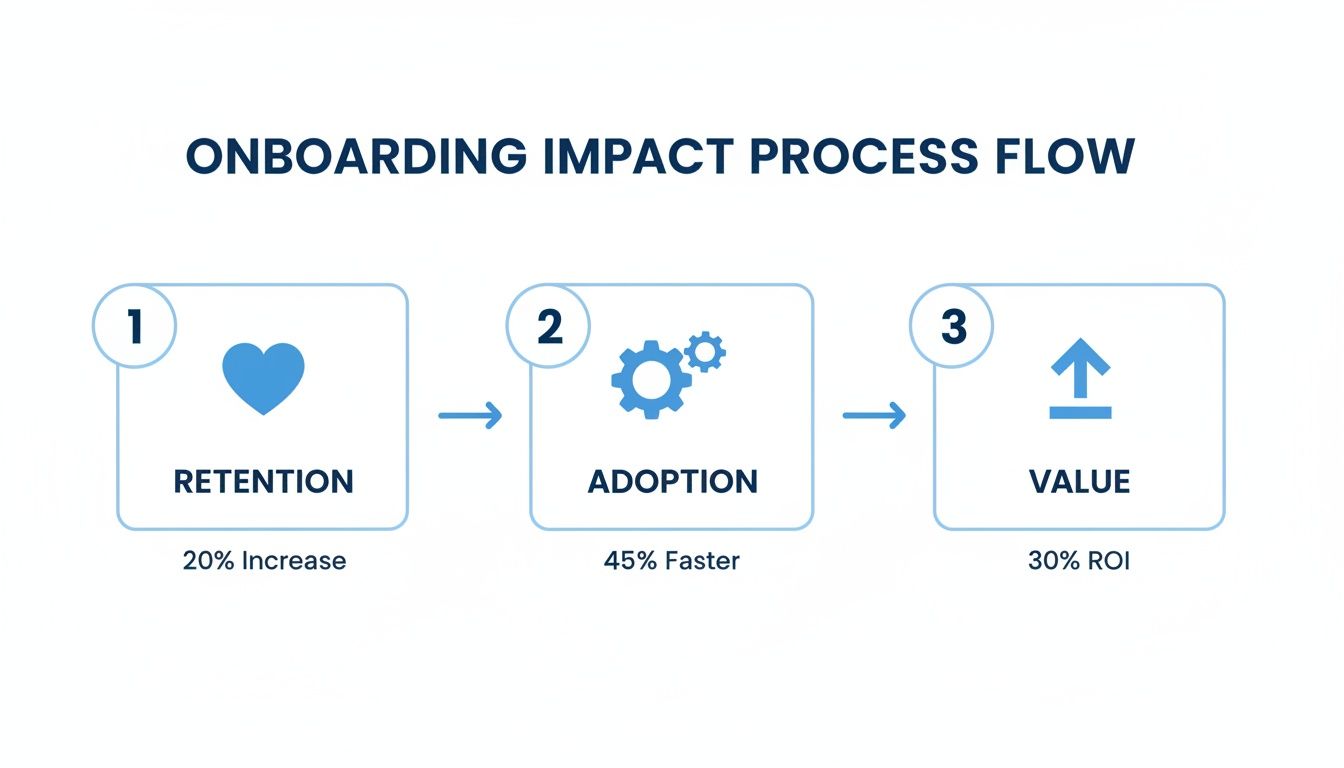
This flow shows that a positive first impression is the engine that drives deeper product use and grows the customer's lifetime value. And the data doesn't lie. An incredible 63% of customers say the company’s onboarding is a major factor when deciding whether to subscribe. What's more, 86% of customers feel more loyal to businesses that provide welcoming and educational onboarding content. If you want to dive deeper, you can explore more onboarding statistics to see the full picture.
To put it all together, here’s a high-level look at what a typical onboarding journey involves.
Key Stages of a Customer Success Onboarding Process
Stage | Primary Objective | Key Activities |
|---|---|---|
Pre-Boarding | Set clear expectations and prepare the customer for a smooth start. | Welcome emails, resource sharing (guides, FAQs), internal handoff from Sales, initial data collection. |
Kickoff | Align on goals, establish a timeline, and build a strong relationship foundation. | Discovery call, defining success criteria (KPIs), introducing the onboarding team, project planning. |
Implementation | Get the customer technically set up and configured for their specific use case. | Account setup, data migration, user training sessions, technical configuration, integration support. |
Adoption | Drive initial usage and ensure the customer achieves their first value milestone. | Regular check-ins, monitoring usage data, sharing best practices, providing targeted training. |
Review | Confirm value has been achieved and plan for long-term success. | Business review meeting (EBR/QBR), showcasing ROI, gathering feedback, planning next steps. |
Each stage builds on the last, guiding the customer from initial setup to becoming a true power user who sees your product as indispensable.
Setting the Stage with Pre-Onboarding and Kickoff Calls
A world-class onboarding experience doesn't kick off when a customer first logs in. It actually begins the second the deal is closed. This crucial initial phase, often called pre-onboarding, is all about creating a smooth, seamless handoff from your sales team to your customer success team. You want to keep the momentum going.
The internal handoff is the first, and arguably most critical, step. I’ve seen it go wrong too many times—the customer is forced to repeat their goals, pain points, and business case all over again. It’s an instant source of friction. A great handoff, on the other hand, means the Customer Success Manager (CSM) walks into that first conversation armed with knowledge and ready to add value from minute one.
This is where a tool like Notize AI can be a game-changer. Imagine recording the final sales calls or the internal handoff meeting and getting an automatic summary, a list of key discussion points, and clear action items. The CSM gets a perfect, data-rich briefing, which cuts out all the guesswork and presents a truly unified front to the new customer.
The Handoff Checklist That Prevents Dropped Balls
To really nail this transition, your sales team needs to pass along more than just a few notes in the CRM. It’s the context and nuance that matter, and this is exactly what technology can help capture.
Here’s a look at the essential info every CSM should have before that first call:
Customer's Primary Goals: What are the specific business outcomes they expect to see?
Known Pain Points: Which problems, specifically, did they mention your product is supposed to solve?
Key Stakeholders: Who’s the executive sponsor? Who’s the project lead? Who are the day-to-day users?
The "Why": Why did they choose you over a competitor, or even over just sticking with the status quo?
Agreed Timelines: Were any go-live dates or implementation deadlines mentioned during the sales process?
Structuring a Powerful Kickoff Call
When you have all that background information, the kickoff call stops being a simple meet-and-greet. It becomes a strategic alignment session. This is your first real chance to validate what you know, set crystal-clear expectations, and position yourself as a trusted advisor from the jump. A well-run kickoff call builds confidence and sets the entire tone for the relationship.
The goal of the kickoff call isn't just to introduce yourself; it's to confirm you've been listening all along. Reiterate the customer's goals in their own words to build immediate trust and alignment.
To keep the meeting on track, send a clear agenda beforehand. Start with introductions, but then quickly move to confirm the key objectives you learned from the sales handoff. From there, you can walk them through the onboarding plan, define success metrics together, and agree on the immediate next steps.
For a deeper look at running effective meetings, check out our guide on establishing helpful norms for meetings. And don't forget to record this call with Notize AI. It automatically captures every decision, timeline, and action item, creating a single source of truth that keeps everyone accountable from day one.
Bringing the Product to Life: Implementation and Training
This is it. After all the discovery calls and kickoff meetings, your customer finally gets their hands on the product. The implementation and training stage is where the rubber meets the road, and a smooth experience here is what separates a successful partnership from a frustrated one.
The goal isn't just to show them how to use the tool; it's to build their confidence and secure that all-important early adoption. This happens when you directly connect the features they're learning to the problems they told you they needed to solve. A generic, one-size-fits-all product tour just won’t work. People check out mentally when you're showing them features that don't matter to their day-to-day work. Focus on guiding them through one or two key workflows that give them a tangible, early win.
Make Training Stick by Focusing on Their World
The best training sessions are always built around the people in the room and the jobs they need to get done. Who are you talking to? What does a good day look like for them? A manager cares about dashboards and high-level reports, while an individual contributor needs to master the nitty-gritty of a specific workflow.
Let's think about this with a real-world example using Notize AI. The training you'd give to a corporate team is completely different from what you'd show a content creator.
For Business Teams: The session would zero in on recording a live meeting. You'd highlight how Notize AI automatically creates a summary, notes attributed to each speaker, and a clean list of action items. The immediate payoff is obvious: they can stop taking manual notes right away.
For Content Creators: Here, the training would focus on uploading a pre-recorded video. You'd walk them through using Notize AI to generate an accurate transcript and a solid first draft of a blog post. The "quick win" is slashing their content creation time.
For Students: The training would showcase how to record a lecture or upload a YouTube link. With Notize AI, they can instantly get summaries, study guides, and even ask the AI questions about the material, finding the exact moment a topic was explained. The value is understanding complex lessons faster.
When you frame training around specific outcomes like these, you shift the conversation from "here's what our product does" to "here's what you can now accomplish." It makes your product feel essential from the very first session.
The goal of training isn't product knowledge; it's user empowerment. Frame every session around what the customer can achieve with the tool, not just what the tool does.
Don't Let Great Training Be a One-Time Event
A live training session is fantastic, but its impact shouldn't disappear the moment the meeting ends. What happens when a new person joins their team six months from now? Or when someone just needs a quick refresher on a feature they don't use often?
This is why documenting your training is a non-negotiable part of a scalable customer success onboarding process.
Recording your training webinars is one of the easiest and most powerful ways to build a library of on-demand resources. Better yet, if you use a tool like Notize AI for the session, you get so much more than a simple video file. The platform can give you a full, searchable transcript, a summary of the Q&A, and even create step-by-step guides based on the demo.
Suddenly, that one-hour training becomes a permanent, searchable asset. A customer can type in a keyword to find the exact moment you explained a feature or review the answer to a question someone else asked. For a deeper look at this, check out these best practices for recording a webinar and repurposing it. This is how you scale your expertise, delivering consistent and high-quality guidance without needing to be on a live call for every single question.
Measuring Success and Reviewing Progress Effectively
So, you’ve built what you think is a stellar onboarding process. But how do you actually know if it’s working? Relying on gut feelings is a recipe for disaster. If you can't measure it, you can't improve it, and you certainly can't prove the value your team is delivering.
This is where a data-driven mindset comes in. Tracking the right metrics turns onboarding from a checklist of tasks into a strategic, value-driven function. It’s all about measuring progress against the specific goals you and the customer agreed on way back in the kickoff meeting. Plus, when you share these wins with your customers, it keeps them engaged and reinforces their decision to choose you.
Key Metrics for a Successful Onboarding
You could track a million different data points, but a few core metrics really tell the story of your onboarding's impact.
Time to First Value (TTFV): How quickly does a new customer get that first "Aha!" moment? This is arguably the most important early signal of long-term retention. A short TTFV means they're seeing the value, fast.
Product Adoption Rate: Are people actually using the features you spent so much time training them on? Low adoption is a major red flag that something is wrong—either the training isn't sticking, or they don't see the benefit.
Customer Health Score: This isn't just one number; it's a blend of several data points like product usage, support ticket volume, and survey feedback. It gives you a quick, at-a-glance view of a customer's overall health and churn risk.
Onboarding Completion Rate: A straightforward but powerful metric. How many customers actually make it through all the milestones you laid out? If this number is low, you've got friction somewhere in your process that needs to be ironed out.
Keeping a close eye on these KPIs allows you to spot trouble before it spirals into a real problem. Think of them as your early warning system.
To get a clear picture of what to track, you need to define your essential success metrics from the start.
Essential Onboarding Success Metrics
Metric | What It Measures | Why It's Important |
|---|---|---|
Time to First Value (TTFV) | The duration from sign-up until a customer achieves their first meaningful outcome with the product. | A shorter TTFV directly correlates with higher long-term retention and customer satisfaction. |
Product Adoption Rate | The percentage of licensed users who are actively using key features within a specific timeframe (e.g., first 30 days). | Low adoption is a leading indicator of churn. It signals that users aren't integrating the product into their workflow. |
Customer Health Score | A composite score based on product usage, support interactions, survey responses (NPS/CSAT), and CSM sentiment. | Provides a holistic view of the customer's relationship, helping to prioritize resources and proactively address risks. |
Onboarding Completion Rate | The percentage of new customers who complete all critical milestones in the onboarding plan. | Identifies friction points in your process. A low rate means customers are getting stuck or disengaged early on. |
Number of Support Tickets | The volume of support tickets logged by a new customer during the first 30-90 days. | A high volume can indicate gaps in training, documentation, or product usability that need to be addressed. |
These metrics aren't just for your internal dashboard; they form the foundation of your conversations with the customer, proving the value you deliver every step of the way.
Structuring Your First Business Review
The first business review, typically held around the 90-day mark, is a massive moment in the customer journey. This isn’t just another check-in call. It's your chance to elevate the conversation from day-to-day tasks to a strategic discussion about the value they’ve received.
Your objective is to connect the dots between their initial goals and the progress they've made so far. You're there to celebrate wins and prove their investment was a smart one. I've found that using a tool like Notize AI to record all the check-in calls leading up to this review is a game-changer. The platform’s automatic summaries and action item tracking give you a clean, documented timeline of every accomplishment you can present.
This first review sets the tone for the entire relationship. When you capture their feedback and generate follow-up tasks right in the meeting with a tool like Notize AI, you're sending a powerful message: we hear you, and we're committed to your success.
The ripple effects of a well-executed onboarding are huge. Research from the Brandon Hall Group found that organizations with strong onboarding processes boost new hire retention by 82% and improve productivity by over 70%. While that study focused on employees, the principle is identical for customers. A great start builds a foundation for a long, successful partnership. You can see the full findings on onboarding statistics for more context.
By consistently measuring your onboarding effectiveness and reviewing progress with your customers, you create a powerful feedback loop. It's a system that not only proves your value but also helps you continuously refine and improve your entire customer success onboarding process.
Scaling Your Onboarding with the Right Tools and Teams
When you're just starting out, a high-touch, manual onboarding process works beautifully. You can give your first ten customers all the personal attention in the world. But that approach hits a wall fast. What got you to ten customers will absolutely cripple you on your way to one hundred.
To grow without stumbling, you need to scale your onboarding. This means bringing in the right technology and structuring your team intelligently. It's not just about becoming more efficient; it’s about freeing up your Customer Success Managers (CSMs). Their real value isn't in ticking off administrative checklists—it’s in having strategic conversations that build lasting relationships and show customers how to get the most out of your product.
Automating the Administrative Burden
Let's be honest, a huge chunk of onboarding is repetitive administrative work. Thankfully, technology is perfect for handling that. You can use project management tools to keep track of tasks and in-app guidance software for automated product tours. But one of the biggest time-drains has always been documenting what happens in meetings.
This is where an AI-powered tool like Notize AI can be a game-changer. Think about it: every kickoff call, training session, and check-in gets recorded. Then, Notize AI steps in to automatically create a structured summary, detailed notes, and a clean list of action items. Suddenly, you have a searchable history of every single customer conversation, and nothing slips through the cracks.
By automating meeting documentation, you give CSMs back their most valuable resource: time. They can immediately shift from being note-takers to strategic advisors, focusing entirely on the customer's success.
This kind of automation also brings incredible consistency. Everyone involved, from your CSM to the customer’s project lead, gets the same accurate record of what was decided and what needs to happen next. No more "I thought you said..." moments.
Building a Dedicated Onboarding Team
But tools are only one piece of the puzzle. As you bring on more customers, it’s time to think about creating a dedicated onboarding team. This isn't just a trend; it’s a proven strategy. The data shows that over 74% of companies now have specialized onboarding teams because they see it as a critical business function.
And with 69% of customer success teams owning the onboarding process, it's clear the industry recognizes how vital this stage is. If you want to dive deeper, you can learn more about these SaaS onboarding trends and see how others are adapting.
A dedicated team means every new customer gets the same polished, high-quality experience. These specialists get incredibly good at what they do, which drives up efficiency and lets your core CSMs focus on the long game: account growth and strategic relationship building.
For example, an onboarding specialist can master running product training sessions. They can record every session using Notize AI, which then becomes a goldmine for creating reusable content. The tool can transform a video into a step-by-step guide or a searchable Q&A, helping you build a rich, on-demand library of resources for future customers. This allows creators and professionals to automatically generate blog posts from video content, complete with AI-powered suggestions to improve engagement and storytelling.
This is all made possible by technology that can produce incredibly accurate transcripts from your video files. If you're curious about the mechanics, you can explore how automated transcription services help create these scalable customer resources. When you pair a focused team with smart automation, you create an onboarding machine that can scale without ever sacrificing quality.
Answering the Tough Onboarding Questions
Even with a rock-solid customer success onboarding process, you're bound to run into some tricky situations. Anticipating these common questions and having a plan ready means you can guide customers with confidence and keep their momentum high. Let’s break down a few of the most frequent ones.
How Long Should an Onboarding Process Be?
There’s really no one-size-fits-all answer here. The perfect timeline hinges entirely on your product’s complexity. A simple, self-serve tool might only need a 30-day onboarding, whereas a sprawling enterprise platform could easily take 90 days or more.
The real goal isn't to hit an arbitrary date on the calendar. It’s about getting the customer to their first major "aha!" moment—that first taste of real value.
Instead of asking about time, try asking, "What are the absolute must-do actions a new customer needs to take to get that first big win?" Once you map that out, the timeline will start to build itself.
How Do You Handle a Disengaged Customer?
A customer going quiet is a huge red flag, but it's not a lost cause. The first thing you have to do is figure out why. Don’t just assume they're not interested. Are they totally overwhelmed? Struggling to see the value? Or maybe they're just bogged down by internal politics?
Your best bet is to reach out with a helpful, "how can I help?" attitude, not an accusatory one.
A great tactic is to reel them back in with a quick, easy win. You could offer a super-short call to show them one specific feature that solves one of their biggest pain points. If you use a tool like Notize AI to record that call, it can automatically send a summary with clear, simple action items. This makes it almost effortless for them to get back on track and can completely reignite their enthusiasm.
What Is the Difference Between Onboarding SMBs and Enterprise Clients?
The fundamental goals are the same—get them to value—but how you get there is worlds apart.
Onboarding SMBs is all about efficiency and speed. Think scalable, tech-touch models. Enterprise onboarding, on the other hand, is a high-touch, strategic project demanding deep customization and careful stakeholder management.
SMB Onboarding: You need a process that can scale. This means relying on things like automated email sequences, in-app tutorials, and a library of on-demand training videos. The aim is to give users the tools they need to help themselves. This is where a tool like Notize AI can be a game-changer. You can take one live training webinar and instantly turn it into a searchable knowledge base of bite-sized guides for all your users. For content creators or everyday users, this means they can send a link from YouTube, TikTok, or Instagram and have Notize AI instantly turn it into a summary, a blog post, or a step-by-step guide.
Enterprise Onboarding: This is a much more customized journey. You're often dealing with multiple departments, complex tech stack integrations, and a whole roster of stakeholders. It requires detailed project plans, regular check-ins with executive sponsors, and training sessions designed specifically for their teams. The Customer Success Manager really becomes a project manager, keeping everyone aligned and moving forward.
By tailoring your approach based on the customer's size and needs, you can deliver a stellar onboarding experience every single time.
Ready to streamline your handoffs and capture every customer goal? With Notize AI, you can automatically record, summarize, and extract action items from all your onboarding calls, ensuring nothing gets missed. Discover how Notize AI can perfect your onboarding workflow today.
Customer Success Onboarding Process: A Proven Guide to Delight New Customers