Meeting norms are basically the shared agreements—sometimes unspoken—that dictate how your team gets things done when you're all in a room (or a video call) together. They're what separate a focused, productive working session from a chaotic waste of everyone's time.
Why Most Team Meetings Fail to Deliver Value
We’ve all been there. You sit through a meeting where the conversation meanders, no real decisions are made, and you walk away wondering what the point was. That feeling is a classic sign of a team running without any agreed-upon meeting norms.
When there's no shared understanding of how to prepare, participate, or follow up, meetings fall apart. Important contributors might hang back, a few loud voices can easily dominate the discussion, and critical action items get completely forgotten. This isn't just an annoyance; it's a huge drain on resources.
The Staggering Cost of Bad Meetings
The financial hit from disorganized meetings is massive. U.S. businesses lose an estimated $37 billion every year to unproductive meetings. For bigger companies, that can mean losing up to $300 million annually.
Think about it: meetings take up a huge chunk of our work lives, yet 65% of people say all that time is mostly wasted. It's not surprising when you learn that only 37% of meetings even start with a basic agenda. If you want to dig deeper, you can explore more detailed meeting statistics that paint a pretty stark picture.
This visual really drives home where all that time and money is going.
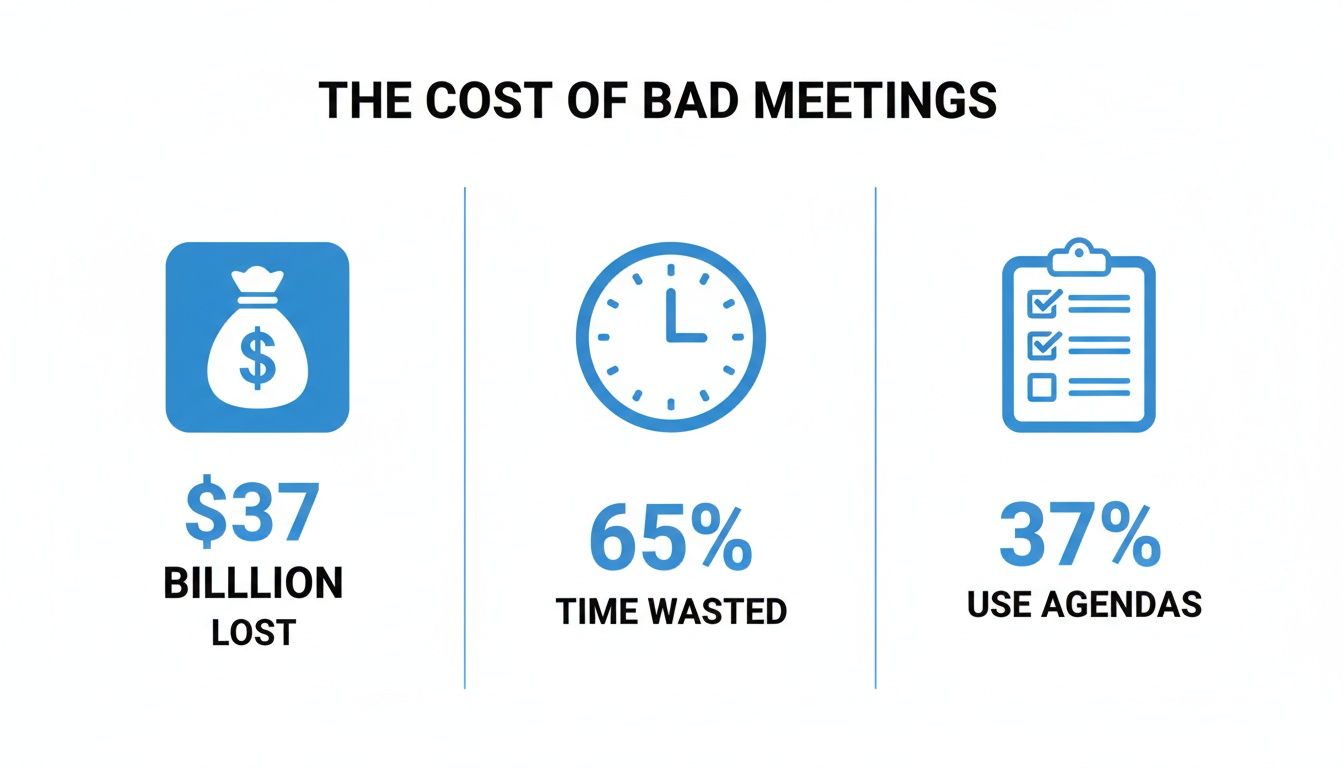
The numbers don't lie. A lack of structure is costing companies a fortune, which is exactly why getting some simple practices in place is so critical.
Creating a Culture of Accountability and Clarity
Putting meeting norms in place is the perfect fix for this chaos. This isn't about creating stuffy corporate rules. It’s about building a foundation for clarity, accountability, and psychological safety where everyone feels comfortable contributing.
When the entire team is on the same page about the "rules of engagement," you see better participation and much more focused conversations.
This is where a tool like Notize AI can make a real difference. It acts like a perfect memory for your team, capturing every decision, key point, and action item without anyone having to furiously type notes.
Instead of ending a meeting with vague ideas, Notize AI automatically records and produces a full, structured meeting summary, key discussion points, and clear action items. It ensures the valuable time you spend together actually leads to real progress.
You're no longer relying on who remembers what. Your team gets an objective, searchable record of what was decided and who owns the next steps. This kind of automation naturally reinforces your meeting norms by baking accountability right into the process. With Notize AI, you can finally make sure every meeting ends with clarity, not more confusion.
Defining Your Team’s Core Meeting Norms
Let’s be honest: nobody wants another top-down mandate. The best meeting norms—the ones that actually stick—aren't handed down from on high. They're built from the ground up, with the team, for the team. The whole point is to create a shared agreement that solves the real, everyday frustrations your team faces in meetings.
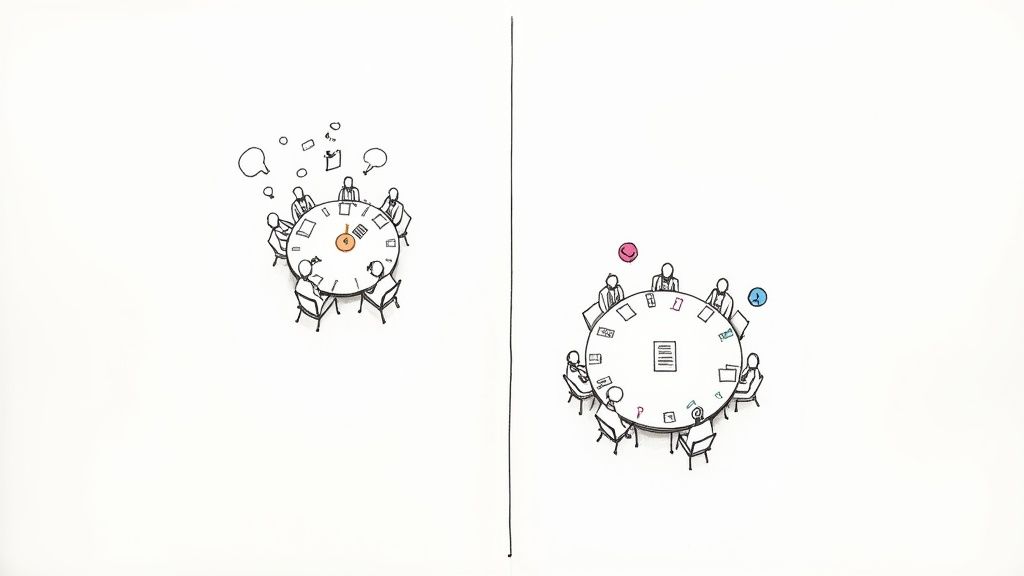
If you start with generic advice, you'll get generic results. Your team's culture, the way you work on projects, and even your communication quirks all matter. I've found it's best to focus the conversation on three core areas that cover a meeting from start to finish: how we prepare, how we participate, and how we make decisions.
A Smarter Way to Brainstorm Your Norms
Okay, so you need to have a meeting to fix your meetings. The irony isn't lost on anyone. This initial brainstorming session can easily spiral into the exact kind of unfocused mess you're trying to eliminate. This is a perfect opportunity to introduce a tool that makes the process itself more efficient and transparent.
Instead of one person being the designated (and frantic) note-taker, let a tool like Notize AI handle the heavy lifting. Just hit record in the app. As your team talks through their pain points and ideas, the platform captures every contribution without bias. Nobody's great idea gets lost because the scribe couldn't type fast enough.
The real magic happens after the call. Notize AI instantly delivers a structured summary. We're not talking about a raw transcript here. It’s a clean, organized report that pulls out the key discussion points, highlights potential norms, and even attributes notes to specific speakers. This gives you a perfect, neutral foundation to start drafting from.
Using an objective tool like Notize AI to capture this foundational conversation is a game-changer. It shows the team you're serious about transparency right from the start. When they can see their own words and ideas reflected in the final document, getting buy-in becomes so much easier.
Turning Good Ideas into Great Habits
That AI-generated summary from Notize AI is your goldmine. Now you can quickly spot the recurring themes and group them into practical categories. This is where you translate the big, fuzzy concepts from the brainstorm into specific, observable behaviors.
For instance, a general complaint like "people aren't prepared" is a good start, but it's not a norm. A real norm is actionable. You can turn that complaint into something concrete: "For all meetings, an agenda will be sent out 24 hours in advance, and everyone is expected to read it beforehand." See the difference? One is a complaint, the other is a clear expectation.
To help you get started, I've put together a table with some common norms I've seen work well for other teams. Don't just copy and paste them—use them as a launchpad for your own conversation.
Sample Meeting Norms Your Team Can Adapt
Use this template of concrete, actionable norms as a starting point for your team's discussion. Adapt them to fit your unique culture and workflow.
Category | Example Norm | How Notize AI Helps |
|---|---|---|
Preparation | Agendas are required for all meetings and must be reviewed by attendees beforehand. | Notize AI helps you build agendas and lets you organize all meeting materials into shared team folders for easy access before a call. |
Participation | We encourage active listening. One person speaks at a time, and all attendees are given an opportunity to contribute. | The speaker-attributed notes from Notize AI can highlight who contributed, helping facilitators ensure discussions are balanced. |
Decision-Making | Key decisions are stated clearly at the end of a discussion, along with the "why" behind them, and documented immediately. | Notize AI automatically identifies and pulls out highlighted decisions, creating a searchable, permanent record. |
Follow-Up | Every action item is assigned a clear owner and a specific deadline before the meeting ends. No ambiguity allowed. | Notize AI automatically generates a list of action items, to-dos, and follow-up tasks from the conversation, keeping everyone accountable. |
Remember, this isn't about creating rigid rules. It's about building a shared framework that makes your time together more focused, productive, and, frankly, more enjoyable.
How to Implement and Document Your New Norms
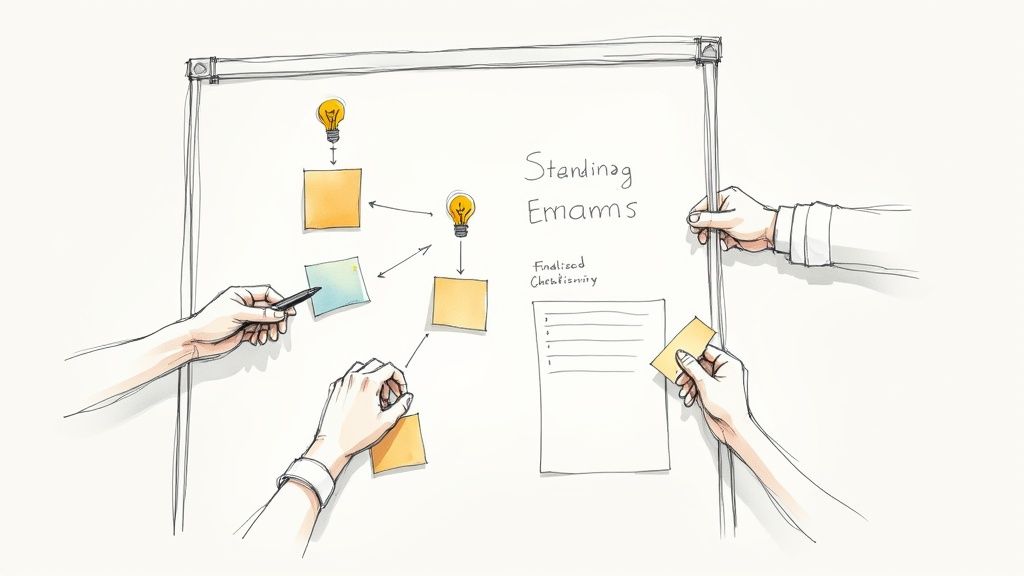
So, you've hammered out a new set of meeting norms. That’s a huge win, but the real work starts now: making them stick. The goal is to get these agreements so deeply embedded in your team’s workflow that they become second nature, not just another list of rules to memorize. This all comes down to smart communication and creating one place everyone can go to find them.
When you first roll them out, frame it carefully. This isn’t about adding red tape; it's a shared promise to make your time together more valuable. Announce the new norms in a team meeting, walk through the "why" for each one, and tie them directly back to the frustrations everyone shared earlier. This really drives home that these are solutions you built together.
Centralize Your Documentation for Easy Access
Your meeting norms need a permanent home—and a visible one at that. A document lost in a labyrinth of shared folders is as good as nonexistent.
Create a single source of truth in your team's main hub, whether that's Confluence, Notion, or even a pinned document in your Slack or Teams channel. The most important thing is low friction. Anyone should be able to find the norms in under 10 seconds.
This is where your tools can do the heavy lifting for you. For instance, with Notize AI, you can set up a shared team folder where all meeting summaries and action items land automatically.
Drop your "Team Meeting Norms" document right into that same Notize AI folder. Now, every time someone pops in to review a meeting summary, they see the norms right there. It’s a constant, subtle reminder that reinforces the standards without you having to say a word.
This simple act of placing the norms alongside your meeting outputs massively boosts the chances they'll be adopted long-term. It makes them part of the natural rhythm of work.
Reinforce Norms Through Your Workflow
Having a document is one thing; bringing it to life is another. Your norms need to be woven into the fabric of your meetings. Here are a few practical ways I've seen this work brilliantly:
Agenda Integration: At the bottom of every meeting agenda, add a simple line as a gentle prompt. Something like, "Friendly reminder: Today we're focusing on our 'No multitasking' norm."
Meeting Summaries: This creates a powerful feedback loop. Notize AI will automatically generate summaries that reflect your norms in action. If a norm is to assign clear owners to action items, the summary will list them. If another is to document all decisions, they'll be highlighted. Our guide on the perfect summary of meeting template shows you how to structure this.
Gentle Nudges: The facilitator's role is crucial here. They can gently guide the conversation back on track when it veers. A quick, "That’s a great tangent, John, let's add it to the parking lot to keep us on schedule," works wonders without making anyone feel called out.
By making the norms a visible part of the entire meeting lifecycle—from the agenda to the final summary—you turn them from a static document into a living, breathing piece of your team culture.
Making Sure Your Meetings Actually Follow the Rules
It’s one thing to have a beautiful document outlining your team's meeting norms. It's something else entirely to see them play out in a real, live discussion. This is where a skilled facilitator makes all the difference.
A facilitator isn't just there to run through the agenda; they are the active guardian of the team's agreements. Their real job is to protect the space so the norms can actually work. That means tactfully steering conversations back on track, making sure everyone gets a chance to speak, and watching the clock. The facilitator is the bridge between good intentions and tangible results.
Your Go-To Phrases for Guiding the Conversation
Keeping a meeting aligned with its norms doesn't require being a drill sergeant. It’s about having a few key phrases in your back pocket to guide the conversation with a light touch.
Here are a few scripts I’ve seen work wonders:
When a discussion goes off-topic: "That's a really interesting point, Sarah. Let's make sure we capture that in the parking lot so we can give it the attention it deserves after we've covered our main agenda items."
When you need to draw out quieter voices: "We've heard some great thoughts from a few people. David, I’d be interested to hear your perspective on this, since you have experience here."
When it’s time to lock in a decision: "It sounds like we're leaning toward Option B. To stick to our decision-making norm, let's do a quick final check for any strong objections before we lock this in."
These simple prompts are polite, professional, and get the team back on track without creating any awkwardness.
Using Tech to Make Accountability Effortless
Let's be honest: a facilitator's job is hard enough without having to manually police every little thing. This is where modern tools can step in and handle some of the heavy lifting.
For example, Notize AI can be your secret weapon in real time. Instead of just hoping people remember what was decided, you can add weight to key moments with simple verbal cues.
When a decision is made, the facilitator can just say, "Great, that’s a clear decision. It's being captured in Notize AI right now." That one sentence makes it official. It's documented. It's real.
The platform’s ability to generate action items with assigned owners provides a layer of automated accountability. When the facilitator assigns a task, knowing Notize AI will capture and list it in the summary makes the commitment more concrete. Even better, users can instantly jump to the exact moment in the recording where that task was discussed for full context.
This lets the facilitator focus on guiding the conversation, not just being a scribe. It’s a huge part of learning how to take meeting notes effectively without all the manual work.
This has become even more critical since the world shifted to remote work. Since 2020, virtual meetings have jumped from 48% to 77% of all meetings, but a lot of teams are still using old-school tools. Tools like Notize AI close that gap, making sure that whether you’re in a conference room or on a video call, your meeting norms are upheld with a clear, reliable record. For more data on this shift, you can check out some fascinating insights on the state of modern meetings from Notta.ai.
Evolving Your Norms with Data, Not Guesswork
So, you’ve hammered out a set of meeting norms with your team. That’s a huge first step, but the work isn't over. Think of these norms not as a static rulebook but as a living document. It needs to breathe and adapt as your team grows, projects shift, and you all get better at working together.
To make sure your new agreements are actually moving the needle, you need to measure their impact.
Are meetings getting shorter? Are we making more concrete decisions? Is participation less lopsided? These aren't just fuzzy feelings; they're data points you can track to see what's truly working.
Use Data to Sharpen Your Norms
The tricky part is collecting this data without piling on more admin work. Honestly, who has time for that? This is where a tool like Notize AI can step in and act as your team’s performance analyst, swapping gut feelings for hard evidence.
Since Notize AI automatically generates a detailed report after every call, you can start spotting trends almost immediately. For instance, you can easily track:
Meeting Duration: Are your calls actually hitting the time limit you all agreed on? Or are they still creeping over?
Decision Volume: A quick keyword search across summaries for "decision" or "agreed" will show if you're getting more decisive.
Action Item Completion: How many follow-up tasks are you generating, and more importantly, how many are getting done?
This gives you a powerful, data-driven feedback loop. You’re no longer just hoping a norm is working; you have the numbers to prove it.
Just imagine pulling up Notize AI reports from the last month. You might discover that meetings with an agenda sent out beforehand are, on average, 25% shorter and produce double the documented decisions. That's concrete proof that a specific norm is delivering serious value.
Build a Rhythm of Continuous Improvement
The end game here is to build an evolving system for better collaboration. I recommend scheduling a quick quarterly check-in specifically to review your meeting norms. Use the insights you've gathered from Notize AI to guide the conversation.
It completely changes the dynamic. Instead of asking a vague question like, "Do our meetings feel better?" you can present a real challenge: "Our data shows we're assigning action items, but our follow-through rate is stuck at 60%. What can we tweak in our norms to fix this?"
See the difference? You’ve moved from subjective gripes to collaborative problem-solving based on what’s actually happening.
This review cycle ensures your norms for meetings don't get stale. A big piece of this puzzle is making sure your action items are crystal clear and trackable from the moment they're created. If you need a hand with that, take a look at our detailed guide for crafting the perfect meeting action items template.
By continuously measuring and refining, you turn a simple set of ground rules into a powerful framework that drives real productivity and keeps your team in sync.
Your Questions About Meeting Norms, Answered
Even with the best intentions, rolling out new meeting habits can hit a few snags. Below are some of the most common hurdles I've seen teams face, along with practical advice to clear them.
How Do We Get Everyone to Buy Into New Norms?
The secret to genuine buy-in is co-creation. People support what they help build. Instead of handing down a list of rules from on high, get the team together for a dedicated session. The whole point is to talk openly about what’s currently broken in your meetings and brainstorm fixes as a group.
This is a perfect time to fire up a tool like Notize AI. Let it record the conversation so you can be fully present. More importantly, it captures every idea and concern without bias, ensuring everyone feels heard.
When you draft the final norms for meetings based on the AI-generated summary, your team will see their own words and ideas reflected back at them. That creates a sense of ownership that a top-down mandate could never achieve.
What if Someone Consistently Ignores the Norms?
It’s bound to happen. When a teammate repeatedly goes off-script, the best first step is a private, constructive chat. A simple one-on-one can uncover why it's happening without making them feel defensive in front of the group.
In the meeting itself, the facilitator's job is to gently steer things back on track. This is where an objective record from Notize AI becomes your best friend. It depersonalizes the feedback entirely.
You can point to the automated summary and action items to highlight the gap between your agreed-upon process and what actually transpired. The conversation immediately shifts from "Why aren't you following the rules?" to "How can we all get better at sticking to our agreement?"
This data-first approach keeps the feedback objective and focused on the team's shared goals, not on individual blame.
How Often Should We Review Our Meeting Norms?
Think of your norms as a living document, not a stone tablet. They need to evolve as your team and business change. A good starting point is a review every quarter, or at the very least, twice a year.
Projects change, teams grow, and priorities shift. A quick check-in ensures your standards are still helping, not hindering, your progress. You can supercharge this review by digging into your Notize AI reports.
Look at the data. Are meeting lengths creeping up? Are decisions being documented consistently? Are action items being assigned to a single person every time? This kind of evidence shows you exactly what’s working and what needs tweaking. Using these insights lets your team refine its norms for meetings based on real performance, not just gut feelings.
Ready to transform your meetings from chaotic time-wasters into productive powerhouses? Let Notize AI handle the note-taking, summarizing, and action-item tracking so your team can focus on what truly matters. Start your free trial today and see how effortless accountability can be.
Practical Norms for Meetings That Actually Boost Productivity