Boosting team collaboration isn't about piling on more software; it’s about building smarter, more intentional ways of working together. The real breakthrough comes when you focus on purposeful communication, crystal-clear roles, and using AI to cut out the administrative noise. This shift lets your team get back to the strategic work that actually matters.
Rethinking Collaboration in the Modern Workplace

Let's be real—the old collaboration playbook is obsolete. For most remote and hybrid teams, the daily grind is a blur of back-to-back meetings, information lost across a dozen different apps, and a nagging sense of being out of sync. Trying to fix this with more software or another daily stand-up usually just adds to the chaos.
The only way to truly fix this is to be more deliberate. It's about designing a system where every interaction has a purpose, everyone knows exactly what they're responsible for, and technology actually helps instead of hinders. This is precisely where modern AI tools can be a game-changer.
The Real Cost of a Disconnected Team
When teamwork falters, it's not just about a few missed deadlines or some team friction. It hits your engagement, crushes productivity, and takes a direct toll on the bottom line. The quality of your frontline managers plays a massive role in this. In fact, research shows that managers are responsible for around 70% of the difference in team engagement.
With a staggering 21% of employees feeling engaged at work globally, we're looking at a huge problem. This widespread disengagement is estimated to cost the global economy billions in lost productivity every year. You can dive deeper into these numbers in Gallup’s 2025 workplace report.
A Smarter Path Forward
What if your team could ditch the administrative busywork and focus entirely on high-impact, creative thinking? Imagine a workday where no one has to frantically type notes during an important client call or a project brainstorming session.
This is where a tool like Notize AI becomes indispensable. For teams and professionals, it automates the tedious parts of meetings by recording, transcribing, and summarizing everything that’s said. Notize AI automatically produces structured meeting summaries, pinpoints key decisions, and pulls out clear, speaker-attributed action items, giving the whole team perfect clarity without anyone needing to do the manual labor. This one change can free up an incredible amount of mental bandwidth for actual problem-solving and innovation.
By automating how you capture meeting intelligence, you give your team the power to move faster and stay aligned. Meetings stop being a time-suck and become a searchable, valuable source of knowledge with Notize AI.
Before we dive into the specific strategies, let's look at the core principles that underpin a truly effective collaboration system. This table breaks down the key pillars that you'll see reflected throughout this guide.
Key Pillars of Modern Team Collaboration
Pillar | Core Problem It Solves | Key Strategy |
|---|---|---|
Purposeful Meetings | Meeting fatigue and lack of clear outcomes. | Design every meeting with a clear goal, agenda, and defined roles for participants. |
Shared Knowledge | Information silos and difficulty finding critical context. | Centralize documentation and use tools like Notize AI that create a single, searchable source of truth. |
Clear Communication | Ambiguity about when and how to communicate. | Establish clear guidelines for different communication channels (e.g., chat vs. email vs. call). |
Role & Workflow Clarity | Confusion over responsibilities and project handoffs. | Define roles, responsibilities, and standardized workflows for recurring tasks. |
Intelligent Tooling | Manual, repetitive tasks that drain time and energy. | Integrate AI-powered tools like Notize AI to automate tasks like note-taking and summarizing action items. |
With these pillars in mind, you're ready to start building a more connected, efficient, and impactful team. Let’s get into the practical steps you can take.
2. Nail Your Meeting and Communication Rhythm
Let's be honest, most of us are drowning in meetings that should have been an email. This isn't just an annoyance; it's a productivity killer, with some folks losing up to 31 hours a month to pointless calls. Getting that time back is one of the biggest wins you can get for your team's collaboration.
The first move is to get ruthless about what actually needs to be a real-time, synchronous meeting. A quick brainstorm to unblock a project? A tricky problem-solving session? Absolutely. Those benefit from the back-and-forth of a live conversation.
But routine status updates, general info-sharing, or simple feedback requests? Those are perfect candidates for asynchronous channels like Slack, email, or your project management tool. Making this simple distinction is how you start clearing up calendars and giving people back their deep-work time.
Design Meetings That Don't Waste Time
When you do need to meet, make it count. I’ve found that the best meetings are built on a simple framework: a clear purpose, the right people, and a solid process.
Have one clear goal: What's the single thing you need to walk away with? If you can't state the desired outcome in one sentence, you probably don't need the meeting.
Be ruthless with the invite list: Only invite people who are absolutely critical to the decision or conversation. Smaller groups mean faster, more focused discussions. Every time.
Give people jobs: Assign a facilitator to keep things moving, a timekeeper to watch the clock, and a clear decision-maker so you don't end up in "analysis paralysis."
Putting these rules in place turns rambling conversations into crisp, decision-making moments. It’s about respecting everyone's time and actually moving the ball forward. If you want to take this even further, building out a set of team-wide norms for meetings is a game-changer.
The real mindset shift is from "having meetings" to "solving problems." A great meeting isn't one that fills the scheduled hour—it's one that hits its goal as efficiently as possible.
Let AI Handle the Note-Taking Grunt Work
One of the biggest drags on any meeting is the manual note-taking. You can't fully engage in the conversation if you're also trying to frantically type down every key point and decision. This is where AI tools are no longer a "nice to have"—they're a fundamental upgrade.
Think about your last project kickoff. Instead of designating a "note-taker" who is only half-present, you just hit record with Notize AI. The second the call wraps up, a structured, intelligent summary lands in everyone's inbox, ready to be shared with colleagues.
And I'm not talking about a messy, raw transcript. Notize AI is smart enough to pull out and organize the good stuff:
Key Decisions: A clean list of what was actually agreed upon.
Action Items: A checklist of who owns what, so nothing falls through the cracks.
Important Insights: The core ideas and takeaways that shaped the conversation.
Suddenly, remote and in-office team members are on the exact same page without a single follow-up email. With Notize AI, every conversation becomes a searchable, usable asset. You can instantly search by keyword to find out who said what, jump directly to the moment a decision was made weeks ago, and keep everyone accountable. It becomes the bedrock of your team's shared knowledge.
Choosing the Right Tools Without Overwhelming Your Team
Tool fatigue is real, and it’s a massive drain on focus and morale. When your team is forced to juggle a dozen different apps just to stay in the loop, real collaboration grinds to a halt. The goal isn't to pile on more software; it’s about simplifying and consolidating around platforms that actually remove friction, not create more of it.
Since 2019, we've seen a 44% jump in the use of online collaboration tools. But more isn't always better. The numbers show that teams using more than ten apps are far more likely to report communication problems (54%) than those using five or fewer (34%). It's a clear signal that tool sprawl leads directly to collaboration breakdowns.
The first step is to audit your existing tech stack. Ask yourself one simple question for each tool: "Does this create a single source of truth, or just another silo?" If it’s not making information easier to find and share, it might be part of the problem.
Creating a Central Nervous System for Knowledge
Your collaboration setup should revolve around a central hub—a place where knowledge is captured, organized, and, most importantly, easy to find. This completely eliminates the scavenger hunt for that one critical piece of information buried in old Slack threads, email chains, or scattered Google Docs.
This is where a dedicated platform can make all the difference. For example, an AI meeting note taker like Notize AI can fundamentally change how your team accesses and uses information from conversations. Instead of relying on someone's hurried, fragmented notes, every important discussion becomes a structured, searchable asset organized into folders for your team or project.
Imagine a sales manager uploading a recorded client call. In moments, Notize AI provides a clean summary of key insights, objections, and action items. This isn’t just about saving time; it's about building a powerful, centralized library of your team's collective intelligence that everyone can tap into.
This infographic lays out a simple but powerful strategy: using intelligent tools to have fewer, shorter, and smarter meetings.
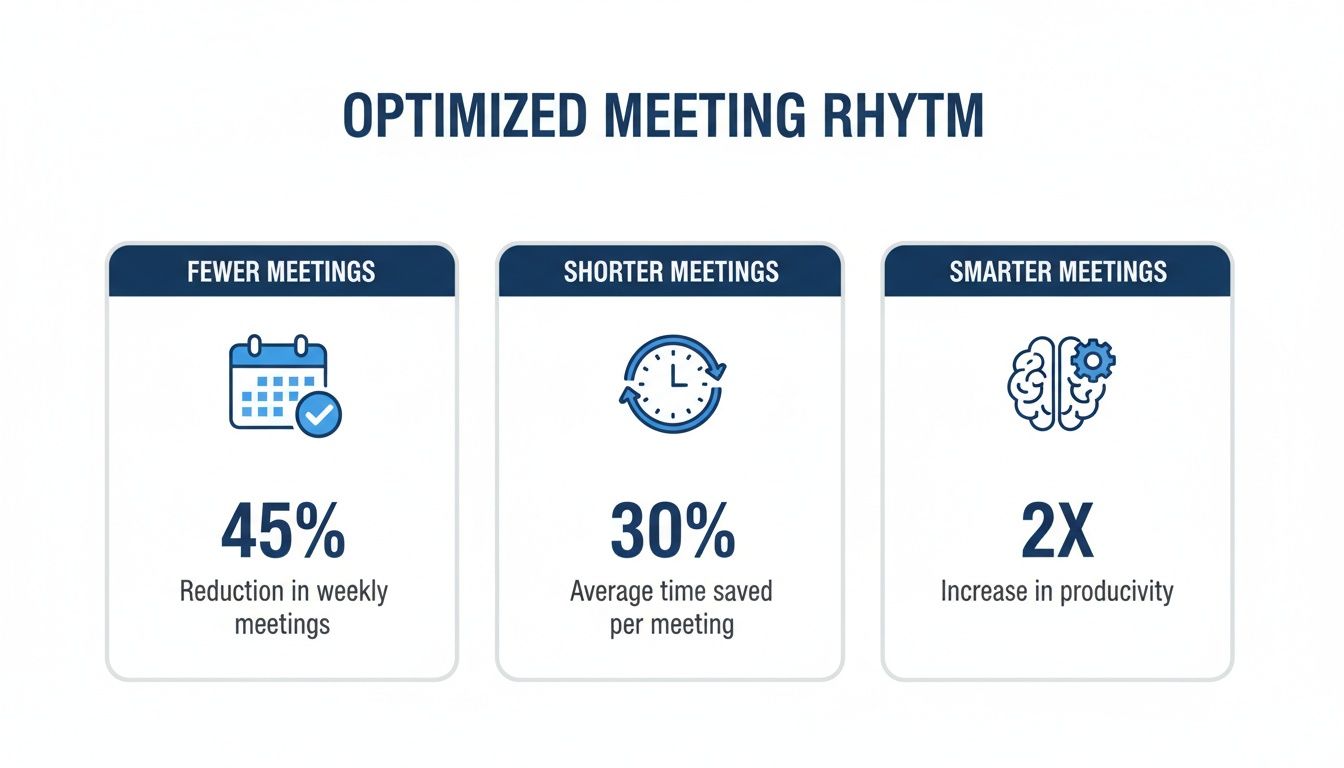
The data here points to a clear path for reclaiming productive time. It’s about shifting the focus from meeting quantity to meeting quality, and that’s only possible when you have the right tools in place.
Integrating AI to Unify Your Workflows
Today's AI tools are about more than just automation; they're about smart integration. They connect the dots between different activities, turning a spoken conversation into a shareable project update without anyone lifting a finger. With a tool like Notize AI, your meetings stop being just another block on the calendar and become the actual starting point for getting things done.
Think about the practical wins here:
Automatic Documentation: Every project kickoff, brainstorming session, or client check-in gets documented and summarized by Notize AI. No more lost details or "he said, she said."
Instant Accountability: Action items are pulled out and assigned to specific team members right from the conversation, which makes follow-up effortless.
Searchable History: Need to remember a decision your team made three months ago? A quick keyword search in Notize AI can pull up the exact moment it was discussed, giving you the full context.
By consolidating all your meeting intelligence into one accessible platform, you give your team that elusive single source of truth. This dramatically cuts down the time spent hunting for information and gets everyone on the same page, fast.
Ultimately, choosing the right tools is often an act of strategic subtraction. By consolidating around an intelligent platform like Notize AI, you reduce the noise and complexity, freeing your team to focus on what they do best—doing great work, together.
4. Design Your Team for Clarity and Impact
Great collaboration doesn't just happen on its own; you have to build it intentionally. It all starts with a smart team design that gets rid of the ambiguity that so often breeds conflict, wasted effort, and duplicated work. The real magic isn't in the tools—it's in how people understand their roles and how decisions get made.
The first, most critical step is establishing crystal-clear roles. When people know exactly what they own, they can move forward with confidence and autonomy. This is a game-changer for hybrid teams, where the "out of sight, out of mind" problem can quickly lead to confusion. If responsibilities are fuzzy, tasks get dropped and accountability simply melts away.
Who Owns What? Defining Roles and Responsibilities
Ambiguity is the silent killer of teamwork. It’s staggering, but research shows that only 47% of employees strongly agree they know what’s expected of them at work. That gap creates friction and grinds progress to a halt as people second-guess their every move. A simple role-clarification exercise can fix this almost overnight.
For every major project or workflow, get specific about:
The DRI: Who is the Directly Responsible Individual? This is the one person who owns the final outcome.
The Approvers: Who are the key stakeholders whose sign-off is absolutely required before moving forward?
The Consultants: Which subject matter experts need to provide input along the way?
The Informed: Who just needs to be kept in the loop on progress?
This simple framework, often called a RACI chart, eliminates the guesswork and empowers everyone to contribute where they're needed most.
Structuring Your Team for Peak Performance
How you structure your team has a direct, measurable impact on its success. Studies have consistently found that small teams, typically around 3–5 members, are powerhouses for complex problem-solving. They hit the sweet spot between having enough diverse perspectives and keeping communication overhead low.
And it pays off. Teams in the top quartile for engagement are about 23% more profitable than those in the bottom quartile. This isn't a coincidence; it shows how thoughtful team design and clear practices translate directly into better business outcomes. You can dig deeper into how disciplined team management improves performance on flowlu.com.
The most collaborative teams aren't just random collections of talented people. They are carefully designed units where everyone understands their part in the larger mission. Clarity breeds confidence, and confidence fuels momentum.
Think about what happens after a big strategic planning session. By using a tool like Notize AI to capture the meeting, every single person gets the exact same summary of what was decided and who was assigned what. The automatically generated action items list out who owns each task, reinforcing accountability from the get-go.
This simple, automated step ensures that whether someone is in the office or working from home, they have the same context. Notize AI builds a culture where everyone sees exactly how their work connects to the bigger picture, driving both clarity and real impact.
Building a Culture of Transparency and Trust
You can have the best tools, the most dialed-in processes, and perfectly defined roles, but none of it matters if your team doesn't have a culture of trust. It’s the engine that powers everything else. Without a foundation of psychological safety, even the most meticulous workflows will start to crack under pressure.
Real collaboration ignites when people feel safe enough to toss out a half-baked idea, admit they made a mistake, or give candid feedback without worrying about getting shot down. This kind of environment doesn't just spring up on its own—it has to be deliberately built and maintained by leaders who model the right behaviors.
Make Knowledge Sharing the Default
One of the fastest ways to build trust is to stop hoarding information. When everyone on the team has access to the same context, history, and data, you dismantle the information silos that create an "us vs. them" dynamic. This is where your day-to-day operations and tools have a massive impact on your culture.
Think about it: instead of critical decisions being trapped in one person's inbox or a private document, you can create a shared brain for the entire team. This is exactly what a platform like Notize AI helps you do. It automatically records, summarizes, and organizes every important meeting, creating a single source of truth that's transparent and searchable for everyone on the team.
Trust isn’t just about believing your teammates mean well. It's about having total confidence in your shared understanding of the situation. When everyone can pull from the same information pool, you get rid of the guesswork that so often leads to conflict.
Picture a new person joining your team. Normally, they’d spend weeks trying to get up to speed by digging through old emails and bugging colleagues. But with a system like Notize AI, they can review structured meeting summaries and understand a project's entire history in a few hours. That’s not just efficient—it empowers them to contribute from day one.
Foster Open Feedback and Celebrate Collective Wins
A culture of trust also hinges on how you handle feedback and success. When feedback is delivered with care and focuses on the work—not the person—it becomes a catalyst for growth, not a source of fear. The best way to encourage this is for leaders to go first, openly asking for feedback and receiving it with grace, not defensiveness.
The same goes for celebrating wins. When you make a point to celebrate success as a team, you reinforce that every single person’s contribution was essential. It sends a clear message that every role is valued.
For example, a project manager could use Notize AI to trace how a critical decision evolved over several meetings. During a post-project review, this creates an objective, data-driven timeline of important moments that removes blame from the equation. The conversation can then shift to improving the process for next time. This shared context is what gives everyone the confidence to speak up, knowing their input is part of a permanent, accessible record.
Ready to Improve Your Team's Collaboration? Here's How to Start.
Overhauling your team's collaboration culture feels like a massive project, but it doesn't have to be. The secret is to start small and focus your efforts.
Instead of trying to fix everything at once, pinpoint your single biggest bottleneck. Are people drowning in back-to-back meetings? Are roles and responsibilities a constant source of confusion? Or is everyone just wasting precious time digging through old emails and chat threads for information?
Pick one of those pain points and commit to solving it. This practical approach is what separates theory from real, tangible results.
A fantastic place to start is by tackling the administrative busywork that drains everyone's energy. Think about all the time spent taking notes, trying to remember who said what, and then writing up summaries. Using a tool like Notize AI to automatically record, transcribe, and pull out key action items from your meetings is an immediate win. It frees up your team's brainpower for the creative and strategic work that actually matters.
The goal here is progress, not perfection. When you solve your most pressing collaboration problem first, you build momentum. It shows everyone that a more intentional way of working together isn't just possible—it's better.
With Notize AI creating a single source of truth from every conversation, you’ll see an instant boost in transparency and alignment across the board. That clarity is empowering. It lets everyone contribute their best work because they know exactly who is responsible for what.
To get even more structured, check out our guide on creating a rock-solid meeting action items template. Honestly, this one small change can kickstart a powerful shift toward a team that's more connected, efficient, and engaged.
Common Questions on Team Collaboration
Let's tackle some of the most common questions leaders have about making their teams work better together. I'll give you some practical, no-fluff answers to get you started.
Where Should I Even Begin to Improve My Team's Collaboration?
Start with your meetings. It's the place where most collaboration happens—or falls apart. For just one week, get a baseline. Use a tool like Notize AI to record and summarize every meeting your team has. The key here is not to change a thing about how you run them. Just observe.
Once you have the automated summaries, key points, and action items from Notize AI, you'll see the patterns immediately. You'll spot where conversations go off the rails, which meetings are just status updates that could have been an email, and how much time is spent on things that don't move the needle. This gives you hard data, not just a gut feeling, to start making real changes.
How Do I Keep My Remote Folks from Feeling Sidelined?
This is a big one. The trick is to build a single source of truth that everyone can access, no matter their time zone or location. When crucial decisions, notes, and next steps are captured automatically and shared in one central hub, it completely levels the playing field.
Think about it: when a tool like Notize AI documents every meeting's outcome and shares it instantly, the person working from their home office has the exact same high-fidelity information as the people who were in the conference room. This isn't just about sharing notes; it's about eliminating the information gap that so often makes remote work feel isolating.
Is It Possible to Have Too Many Collaboration Tools?
Absolutely. We see it all the time. Tool sprawl is a massive productivity drain. When your team is bouncing between Slack for chats, Asana for tasks, Google Drive for docs, and Zoom for calls, context switching kills their focus and scatters important information.
The best move is to simplify and integrate. A smart play is to use a tool that consolidates knowledge from your conversations. For instance, Notize AI can act as that central hub for everything discussed in meetings, preventing your team from having to dig through five different apps to find out what was decided. It’s about creating one place to find the answers, not more places to look for them.
Ready to stop the meeting madness and give your team a single source of truth? Notize AI automatically takes notes, pulls out key decisions, and creates clear to-do lists from all your calls. Start improving your team collaboration today.
How to Improve Team Collaboration for Real Productivity Gains