It's a strange paradox, isn't it? We're swimming in more data, documents, and recordings than ever, yet finding a straight answer at work can feel like an impossible task. This is the heart of the modern knowledge management problem.
Many teams are dealing with a digital equivalent of a massive library where new books appear every minute, old ones are constantly being revised, and there's no central card catalog to make sense of it all. It's pure chaos.
Why Knowledge Management Still Feels Broken
The core challenge isn't a lack of information; it's the struggle to connect with the right information when it matters. Valuable insights from meetings, critical project updates, and customer feedback get scattered across a dozen different apps, quickly becoming outdated, forgotten, or simply lost in the noise.
The Disconnected Tools Dilemma
One of the biggest culprits behind this mess is our reliance on a patchwork of disconnected systems. When the key takeaways from a Zoom call are trapped in a recording, project plans live in one tool, and customer feedback is siloed in another, creating a single, reliable source of truth is nearly impossible.
This fragmentation forces people to spend a huge chunk of their day just hunting for information instead of actually using it to do their jobs. The numbers back this up: a recent survey found that a whopping 36% of organizations use three or more separate knowledge management tools. Another 12% are juggling two or three.
Even more telling? 31% couldn't even say for sure how many systems they had in play. That's not just messy; it's a direct drain on productivity.
To put these issues in perspective, here's a quick look at the most common challenges and how they directly impact your teams.
Common Knowledge Management Challenges and Their Impact
Challenge | Primary Impact on Teams |
|---|---|
Knowledge Capture | Valuable insights from meetings and conversations are lost forever. |
Organization | Information is scattered and unstructured, making it nearly impossible to navigate. |
Searchability | Employees waste hours hunting for information instead of finding it instantly. |
Knowledge Silos | Teams work in isolation, leading to duplicated effort and missed opportunities. |
User Adoption | The system is too complex or clunky, so no one actually uses it. |
Governance | Without clear ownership, information quickly becomes outdated and untrustworthy. |
These challenges create a cycle of inefficiency that's tough to break without a new approach.
From Chaos to Clarity
This is where modern solutions like Notize AI come in. Instead of just adding another tool to the pile, the goal is to unify scattered information automatically. A platform like Notize AI can act as a central brain for your team, connecting to your existing tools to capture, organize, and surface knowledge for you.
Think about all the crucial information shared in your team meetings. A professional can start recording directly in Notize AI, which then automatically produces a full summary, key discussion points, and a detailed list of action items once the meeting ends. Suddenly, a conversation that would have vanished becomes a permanent, easy-to-find asset.
By automating the tedious work, Notize AI helps overcome the friction that causes so many knowledge management plans to fail. To get a better handle on the basics, you can explore our guide on what a knowledge management system is and how it works.
The Seven Core Knowledge Management Challenges
Trying to manage information in a growing organization can feel like trying to drink from a firehose. The sheer volume of data, conversations, and documents we create every day is staggering, and it often buries the exact piece of information you actually need. These aren't just minor annoyances; they're symptoms of deeper, systemic knowledge management challenges that prevent teams from doing their best work.
To really fix the problem, you first have to understand what's broken. Let's dig into the seven most common issues I've seen plague modern companies, exploring how they show up in the real world and the damage they do to productivity and smart decision-making.
This diagram shows how information overload, organizational silos, and disconnected systems are all tangled together.
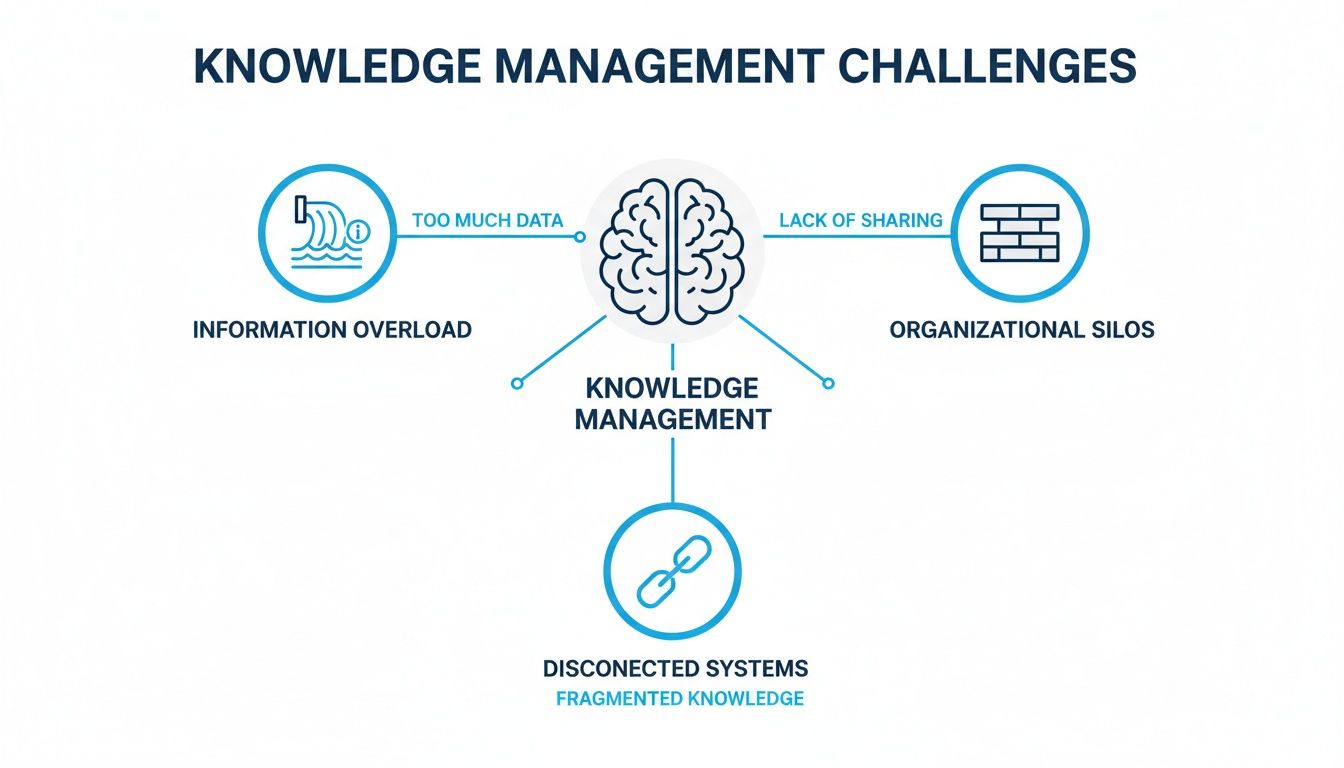
As you can see, these problems don't exist in a vacuum. They feed into one another, creating a complex web of inefficiency that's almost impossible to untangle without a clear, unified strategy.
Challenge 1: Information Overload
The most obvious challenge is simply too much noise. Teams are drowning in a constant flood of emails, chat messages, meeting recordings, and documents. While having data is great, having too much unstructured data just becomes a burden.
Think about a marketing team trying to pull insights from a dozen different social media platforms, analytics dashboards, and customer feedback surveys. With a tool like Notize AI, they can process links from YouTube or social media, automatically summarizing long videos to extract key takeaways in seconds. This turns overwhelming data into actionable intelligence.
Challenge 2: Knowledge Silos
Knowledge silos are those invisible walls between teams and departments. When crucial information gets trapped within one group—like customer feedback stuck in the support team that never makes it to the product developers—the entire organization pays the price. This happens all the time, usually because of incompatible software, departmental politics, or just a culture that doesn't encourage sharing.
For example, a sales team might have incredible insight into customer objections, but if that knowledge isn't shared with marketing, the marketing team can't create content that addresses those specific pain points. You end up with misaligned messaging and lost opportunities.
Challenge 3: Inefficient Search
What good is all this knowledge if you can't find it when it matters? A terrible search function is a massive productivity killer. You know the drill: employees end up bugging colleagues for information they know exists but can't find, interrupting everyone's workflow and wasting time. It's the digital version of searching for a book in a library with no card catalog.
A project manager might remember a key decision being made on a Zoom call two months ago but has no way to find that exact moment without scrubbing through hours of recordings. This is a perfect example of a problem that platforms like Notize AI solve. By making every spoken word in a meeting searchable, Notize AI lets you jump to the precise moment a topic was discussed.
Challenge 4: Poor User Adoption
A knowledge management system is only useful if people actually use it. So many initiatives fail because the tools are too complicated, require a ton of manual data entry, or don't fit into how people already work. If using the system feels like a chore, your team will abandon it in a heartbeat.
This is where automation is a game-changer. Instead of asking teams to manually upload meeting notes, a tool like Notize AI can automatically record, transcribe, and summarize meetings. It creates a rich knowledge asset with zero extra effort from the user. This removes the friction that kills adoption and makes knowledge capture a natural part of the workday.
Challenge 5: Lack of Governance
Without clear rules and ownership, a knowledge base can quickly become a digital junkyard filled with outdated, inaccurate, or redundant information. This chaos erodes trust in the whole system. When employees can't rely on the information they find, they stop using it, and the platform becomes useless.
A knowledge base with poor governance is often worse than no knowledge base at all. It actively misleads team members and undermines confidence in organizational data, leading to flawed decisions.
With Notize AI, teams can organize meetings and content into shared folders, ensuring everyone has a clear and consistent understanding of what happened and making it easier to manage and update information.
Challenge 6: Tacit Knowledge Loss
Some of the most valuable information in your organization is tacit knowledge—the unwritten expertise, instincts, and hard-won experience inside the heads of your most seasoned employees. When these experts leave, that knowledge often walks right out the door with them, leaving a massive gap.
This is a huge risk, especially in specialized fields. Capturing this "tribal knowledge" is one of the toughest nuts to crack. By recording conversations, training sessions, and brainstorming meetings, tools like Notize AI can help turn this spoken, tacit knowledge into explicit, searchable assets that stay with the company long after an employee has moved on.
Challenge 7: Measuring ROI
Finally, how do you prove any of this is actually working? It’s tough. How do you put a dollar value on finding an answer in 30 seconds instead of 30 minutes? Without clear metrics, getting budget and executive buy-in for these projects feels like a constant uphill battle.
The key is to connect your knowledge management efforts to tangible business outcomes. By tracking metrics like reduced onboarding time for new hires, fewer redundant support tickets, or faster project completion rates, you can start to paint a clear picture of the return on investment and justify continued support for building a true knowledge-sharing culture.
Breaking Down the Silos Where Knowledge Hides
Information silos are easily one of the most destructive and stubborn problems any business will face. I like to think of a typical organization as an archipelago—a chain of islands. Your sales team is one island, marketing is another, and customer support, product development, and HR are all their own separate landmasses.
Each island has its own unique resources, valuable insights, and deep expertise. But without any bridges connecting them, they stay isolated. Information gets trapped, collaboration grinds to a halt, and the organization can't function as one cohesive unit.
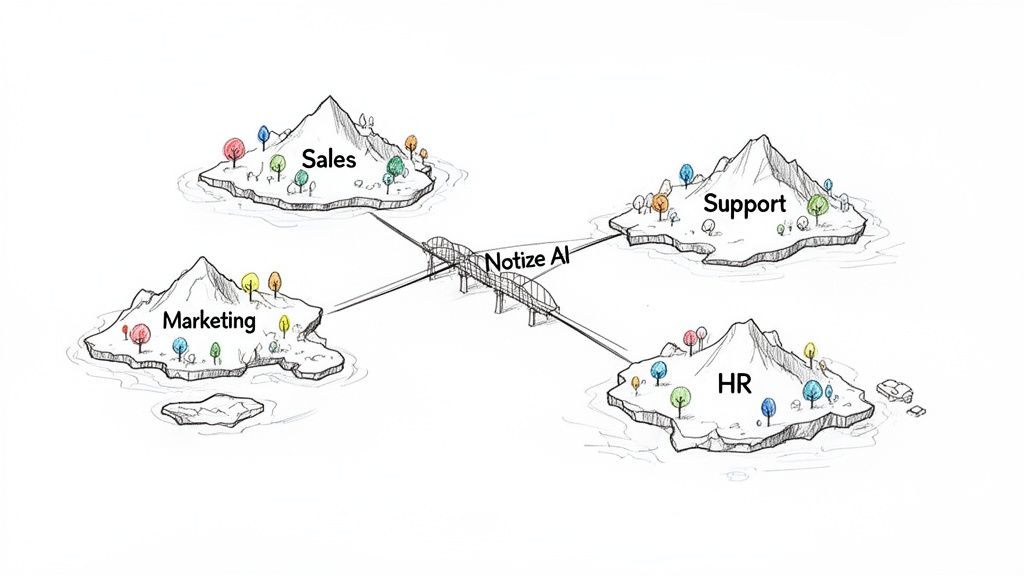
This separation creates massive blind spots and inefficiencies. Teams end up duplicating work they didn't know was already done, big strategic decisions are made with only half the picture, and great ideas die on the vine simply because they never crossed departmental lines.
What Creates These Information Islands?
Silos don't just spring up overnight. They're built over time, often unintentionally, brick by brick. Several factors are usually at play, turning otherwise vibrant teams into isolated hubs of information.
Technology Divides: Different departments rely on specialized software that simply doesn't talk to each other. The CRM your sales team lives in is a completely different world from the project management tool engineering uses, creating a hard technical barrier to sharing.
Organizational Structure: Traditional, hierarchical structures can accidentally reinforce a "stay in your lane" mentality. When teams are judged solely on their own KPIs, there’s very little incentive to share information that might help another department succeed.
Cultural Barriers: A competitive or distrustful internal culture is a powerful silo-builder. If people feel that their unique knowledge is their source of job security, they're more likely to hoard it than share it freely.
The impact here is huge. Reports show that 33% of companies are actively struggling with data locked away in silos, making effective teamwork feel almost impossible. This problem has only gotten worse in our current remote and hybrid work setups, where leaders see these knowledge gaps as a primary threat.
Building Bridges with Automated Knowledge Capture
Tearing down these silos takes more than just good intentions; you need a practical way to build bridges between the islands. This is where a central, automated platform becomes a game-changer. An intelligent tool can act like the connective tissue for your whole organization, pulling information from scattered sources and making it accessible to everyone.
This is exactly what Notize AI was designed to do. It doesn't force your teams to abandon the specialized tools they love. Instead, it integrates with their existing workflows to automatically capture and centralize the knowledge they're already creating.
By pulling in content from scattered sources like Zoom meetings, Google Docs, and even YouTube videos, a tool like Notize AI builds a single, searchable source of truth that demolishes the walls between teams.
Think about this real-world scenario. Your customer success team wraps up a call with a key client who shared some critical feedback about a product feature. In a siloed company, that crucial insight might live and die in a private call log, never to be seen again.
But with Notize AI in place, that meeting is automatically recorded, transcribed, and summarized. The key feedback is highlighted and instantly becomes searchable for the entire product team. A developer working on that very feature can now find real-world customer input in seconds, without ever needing to schedule another meeting. This is a core part of putting effective document management system best practices into action.
This seamless flow of information turns isolated data points into collective intelligence. It gets everyone building from the same blueprint and pulling in the same direction.
The Hidden Costs of Outdated Systems and Poor Adoption
When a knowledge management system fails, it's not just a minor hiccup—it's a slow, expensive drain on your entire organization. The real costs aren't just about the software license; they show up in lost productivity, frustrated teams, and bad business decisions. Too many companies are stuck with clunky, legacy systems that feel more like a digital attic than a strategic asset.
Think about it. These old platforms often demand tedious manual data entry, a confusing tagging system, and constant upkeep. It’s a recipe for frustration. When an employee has to dig through a maze of nested folders and outdated documents just to find one piece of information, they’ll eventually stop trying. And that leads us to the biggest killer of any knowledge initiative: poor user adoption.
The True Cost of a Failed System
The financial bleeding from a system nobody uses is staggering. Companies are pouring money into platforms, but the high price tags and steep learning curves are major roadblocks. The global knowledge management market ballooned to $773.6 billion in 2024 and is expected to climb to $3,562.8 billion by 2034.
Despite this massive investment, many businesses—especially smaller ones—are scared off by the cost and complexity. It’s a classic problem: leaders get pulled into more immediate fires, and employees just don’t have time to learn yet another tool. You can explore more about these market trends and see how they impact businesses.
This is where the hidden costs start to add up:
Wasted Hours: Your team spends hours every single week either searching for information that should be at their fingertips or, worse, redoing work that someone else has already done.
Employee Burnout: Forcing people to use inefficient, frustrating tools is a one-way ticket to burnout. It adds unnecessary stress and is a quiet contributor to employee turnover.
Flawed Decisions: When decision-makers can't get their hands on reliable, current data, they're left to rely on gut feelings. That’s a recipe for costly strategic mistakes.
Shifting from Manual Effort to Effortless Automation
So why do most of these initiatives fail? It comes down to one word: friction. They ask busy people to do more work—manually write up notes, upload files, tag documents, and organize everything just so. This is where a modern tool like Notize AI completely changes the game. Instead of being another system your team has to actively manage, it just works in the background.
With Notize AI, capturing knowledge becomes a natural byproduct of the work you're already doing. For consultants or managers stuck in back-to-back meetings, there’s no need to delegate a notetaker. Notize AI joins the call, records it, and automatically generates a structured summary, a clean list of action items, and a fully searchable transcript. The knowledge is captured perfectly, with zero extra effort.
A knowledge management tool should adapt to how your team works, not the other way around. The best systems are the ones your team doesn't even notice they're using because the value is delivered automatically.
Driving Adoption Through Immediate Value
By getting rid of the manual busywork that everyone hates, Notize AI makes adoption feel natural. It doesn't ask a journalist to pause their workflow to summarize an interview; it generates a high-quality blog post draft directly from the recording. It doesn't force a student to re-watch a two-hour lecture; Notize AI lets them ask a specific question and instantly jumps them to the exact moment the professor explained that concept.
This approach flips the old model on its head. Value comes first. For your team, Notize AI acts as a silent partner that makes their jobs easier from day one. It ensures that critical knowledge is captured, organized, and accessible without anyone having to lift a finger. This is how you finally solve the adoption problem and unlock the real power of your organization's collective intelligence.
Using AI to Automate Your Knowledge Flow
Let's be honest: most knowledge management initiatives fail for one simple reason. They ask already-busy people to do more work. Expecting your team to meticulously document every process, summarize every meeting, and tag every single file is a surefire way to see your shiny new system gather dust. The answer isn't to work harder; it's to make capturing knowledge an effortless, automatic part of the day-to-day grind.
This is where AI-powered platforms like Notize AI completely change the game. Instead of treating knowledge management like a chore, they weave themselves directly into the tools your team already uses. By automating the grunt work—the capturing, organizing, and summarizing—AI turns scattered conversations and messy files into a unified, searchable brain for your entire company.
From Manual Note-Taking to Automated Insights
Think about one of the biggest black holes for company knowledge: meetings. We've all been there. Critical decisions get made, brilliant ideas are thrown around, and key action items are agreed upon... only to evaporate the second the video call ends. Relying on manual notes is spotty at best and a huge distraction for whoever gets stuck with the job. This is where automation delivers an immediate, obvious win.
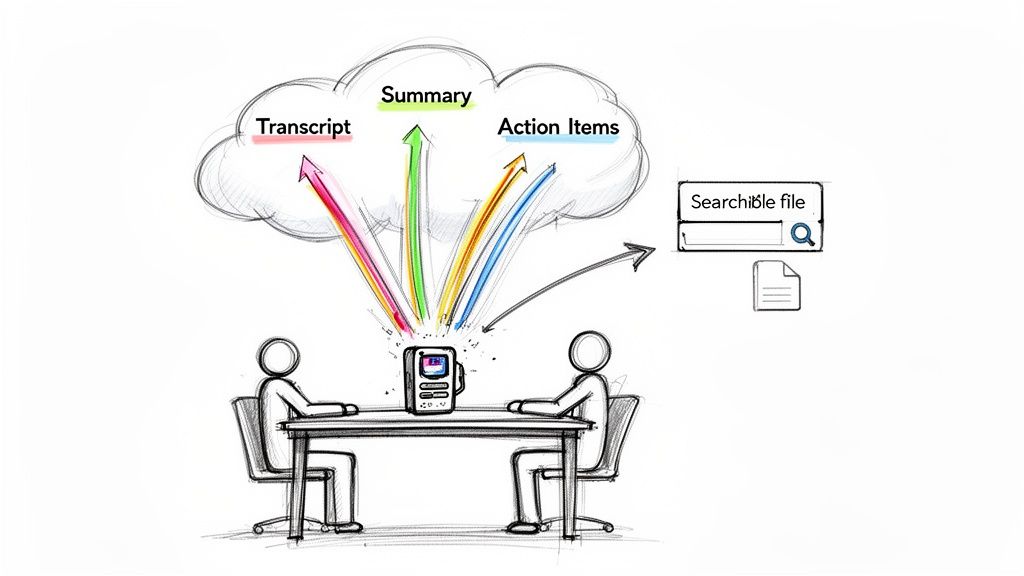
Imagine a project team running a brainstorming session. Instead of designating a notetaker, they just let Notize AI listen in. The moment the meeting wraps up, Notize AI instantly delivers:
A full, structured meeting summary that hits all the high points.
A clean list of action items and to-dos, neatly assigned to the right people.
A complete, searchable transcript where you can see exactly who said what.
Suddenly, that recording and its outputs become the definitive record. Anyone who missed the meeting or just needs to recall a specific detail can find it in seconds. All that ambiguity and “I thought you said…” disappears. The manual work is gone, but the knowledge is captured with perfect accuracy.
Turning Existing Content into New Assets
This kind of automation goes way beyond just meetings. Content and marketing teams, for example, are always under pressure to create more material. They're often sitting on a goldmine of existing content—webinars, interviews, product demos—that could be repurposed if only they had the time. This bottleneck is one of the most common knowledge management challenges we see.
With Notize AI, a marketing team can unlock all that trapped value almost instantly. Say a creator wants to make a blog series from a recorded interview. The old way involved someone spending hours watching, transcribing, and pulling out key points. The new way? Just upload the audio into Notize AI.
The platform chews through the recording and, in a few minutes, spits out high-quality blog drafts, key takeaways, and even social media blurbs in any writing style. The workflow for creating that content just shrank from a full day to about 15 minutes.
This isn't just a marketing trick. A student can upload a two-hour lecture to Notize AI and get back a perfect study guide. They can even upload PDFs or PowerPoints and ask AI questions about the content. The AI adapts, making the whole process of turning raw information into useful knowledge feel almost like magic. To see just how deep this goes, you can learn more about how to use AI for content creation in our detailed guide.
Building a Self-Organizing Knowledge Base
The end goal here is a knowledge base that grows and organizes itself without needing a full-time librarian. An AI-powered system like Notize AI acts as that central hub, intelligently sorting all the information it processes.
When a manager records their team meetings, Notize AI can automatically file them under the right project folder. When a video enthusiast saves clips from social media, the platform makes them searchable by what's in them, not just their vague titles. This automated organization is what prevents your knowledge base from turning into a digital junkyard over time.
By building Notize AI into your existing habits, you sidestep the biggest hurdle that trips up most KM systems: adoption. It doesn't ask you to learn a new process; it just makes your current ones smarter by capturing knowledge invisibly in the background. It’s a practical, immediate fix for some of the most stubborn problems in business.
We Need a Knowledge Culture, Not Just More Tools
Let’s be honest: you can’t just buy a tool and expect your knowledge management problems to disappear. I’ve seen it happen time and time again. While great technology is a huge piece of the puzzle, the real, lasting fix is a change in culture. It's about shifting the entire team’s mindset from hoarding information to one of open collaboration and shared intelligence.
This has to start at the top. When leaders actively share what they're working on and reward others for doing the same, it sends a powerful message. People need to see that contributing to the company's "collective brain" is actually valued and recognized. The goal is to make sharing what you know feel as natural as grabbing a cup of coffee, not another box to check.
Kicking Off the Cultural Shift
So, how do you actually start changing habits? This is where a smart, automated tool can act as the perfect catalyst. The single biggest killer of a sharing culture is friction. If adding to the knowledge base is a pain—if it's slow, clunky, or just one more thing to do—even the most well-intentioned people will just give up.
An automated platform like Notize AI is designed to completely remove that friction. It turns the act of capturing and sharing knowledge into a seamless byproduct of the work you're already doing, which is the key to getting everyone on board.
Think about it. When a manager’s meeting notes are automatically generated and shared by Notize AI, a new standard of transparency is set without anyone having to lift a finger. Or when a content creator can transform an interview transcript into a draft for a blog post with a single click in Notize AI, they're far more likely to share that raw insight with the rest of the team.
By pairing the right AI with a deliberate push for a more open culture, you can finally start to chip away at those stubborn knowledge management challenges. All that scattered information stops being a liability and starts becoming your team's most valuable strategic asset.
The best way forward is to start small with a single, high-impact change. Try fostering this new culture by simply automating the knowledge from your very next meeting. Let Notize AI handle the notes, and watch how it frees up your team to focus on what actually matters: innovating together.
Got Questions? We've Got Answers
It's one thing to understand the challenges of knowledge management, but it's another thing entirely to figure out how to solve them. Let's tackle a couple of the most common questions that pop up when teams decide it's time to build a better system.
How Do We Pick the Right Tool?
The sheer number of tools out there can be paralyzing. The secret is to stop looking at features and start by pinpointing your team's biggest source of pain.
Are brilliant ideas from brainstorming sessions vanishing into thin air? Is your content team spending more time transcribing videos than actually creating? Your goal should be to find a solution that zeroes in on that specific problem without adding a bunch of new busywork.
For instance, if your most valuable insights are locked away in conversations and video calls, a platform like Notize AI is built for that exact scenario. It automatically captures notes, summaries, and action items from meetings, solving the manual documentation nightmare and making all that spoken knowledge findable and useful.
How Do We Get People to Actually Use a New System?
This is the make-or-break question, isn't it? The best system in the world is useless if nobody uses it. The key to adoption isn't more training—it's choosing a tool that weaves itself into how your team already works.
If a new system feels like just one more chore on a never-ending to-do list, it’s dead on arrival.
This is where automation becomes your best friend. With a tool like Notize AI, there isn't really a new process to learn. Your team just runs their meetings like they always do, and the knowledge gets captured and organized behind the scenes. For a content creator, it’s as simple as dropping in a video link to get a first draft of a blog post. The system delivers value without demanding effort, which makes people want to use it.
Ready to stop chasing down information and start putting it to work? Notize AI turns your team's scattered conversations and files into a central, searchable, and genuinely useful knowledge base.
Start streamlining your knowledge flow with a free trial of Notize AI today!
Solving the Top Knowledge Management Challenges in Business